

There is a quiet crisis unfolding across the world, and nowhere does it hide more deeply than in the Middle East.

According to the World Health Organization, the global median number of mental health workers stands at just 13 per 100,000 people — the equivalent of a single professional serving an entire stadium of 8,000 individuals. For those living in the Middle East, the gap is even wider. Researchers at Springer Nature have documented that only a tiny fraction of people in the region with mental illness can access evidence-based care, with access constrained by insufficient funding, a shortage of skilled professionals, substantial out-of-pocket costs, and one of the most persistent forces of all: stigma.
That stigma is not merely social discomfort. Published research in the Asian Journal of Psychiatry identifies deep cultural, religious, and familial influences that shape how mental health is perceived across the Arab world. A 2025 study from primary care centers in Riyadh found that 94% of respondents reported at least one barrier to seeking mental health care, with the most common being the preference to handle struggles privately, concern about being labeled, and fear of having a mental health diagnosis recorded in medical files.
For millions of people, suffering in silence has felt like the only option.
WHJ Online Therapy Centre was built for exactly those people.

A Family Journey Across Continents and Cultures
The story of WHJ does not begin in a boardroom or a clinic. It begins with a family.
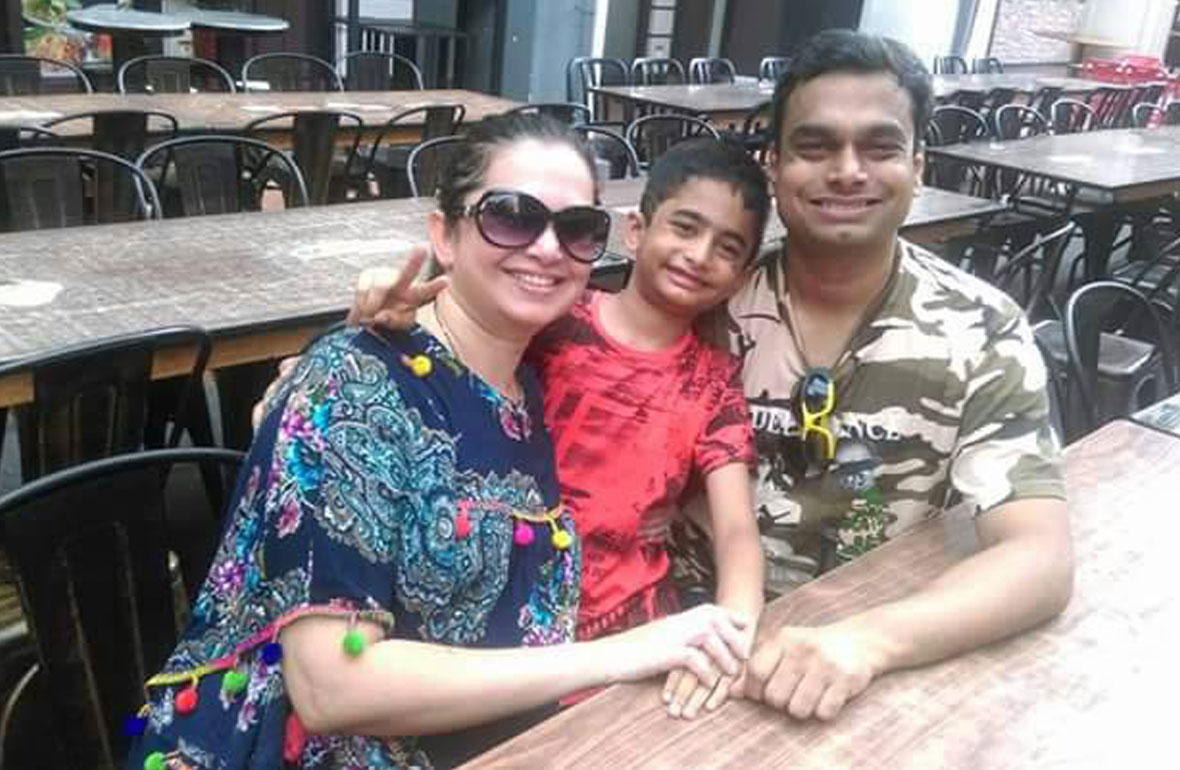
Asit Ranjan Roy Chowdhury and Likha Roy Chowdhury left India for Oman in search of something both personal and practical: a life that could support cross-cultural community and meaningful trade. What they carried with them was not only ambition, but a deep awareness of what it feels like to navigate unfamiliar systems, cultural expectations, and the invisible weight of belonging somewhere between two worlds.
Their children would carry that awareness forward. Dr. Anney Roy, co-founder of WHJ Online, became a consulting psychologist. Her brother, Anoy Roy, built expertise in business management and financial administration. Together, they transformed a family legacy of community service into an organization that now spans continents and disciplines.
WHJ Archway Enterprises carries more than 50 years of combined experience in export and import, construction, finance, psychometrics in healthcare, and consulting. But the WHJ Online Therapy Centre, launched as a virtual platform, emerged from a far more personal observation: that capable, driven, talented people were struggling — not because they lacked ability, but because the systems around them were not built to support them.
The People No One Was Reaching
When WHJ Online took shape, its founders looked closely at who was being left behind.
They saw individuals who were unskilled, semi-skilled, or highly skilled — people who genuinely aspired to enter corporate sectors in the Middle East but found themselves blocked by barriers that had nothing to do with talent. Language differences made workplace integration difficult. Cultural and professional adaptation created invisible walls. Women, in particular, encountered structural limitations in gaining recognition for their businesses and advancing in their careers.
And underneath all of it, many of these individuals were also carrying psychological weight that had nowhere to go. In a region where, as Frontiers in Health Services research notes, mental health stigma remains deeply rooted in cultural, religious, and societal norms, asking for psychological support could feel like a greater risk than enduring the difficulty alone.
WHJ Online chose not to separate these two realities. Instead of treating mental health and professional development as distinct concerns, the organization built a platform where both could be addressed together — because for many of its clients, they were never separate to begin with.
What Integration Actually Looks Like
The practical shape of WHJ’s work is both grounded and ambitious.
For individuals entering Middle Eastern workplaces, the organization embedded communication and cultural support directly within its developmental programs. For women navigating regulatory and structural barriers, WHJ worked within existing frameworks to help them build credentials, resilience, and professional visibility. For those carrying psychological burdens that were limiting their ability to work and connect, trained specialists offered structured support.
To strengthen the quality of support offered, WHJ Online collaborated with specialists whose training and professional development included exposure to leading global institutions such as Oxford, Cambridge, Charles University, and Harvard. What Dr. Roy and her colleagues built was not a one-size-fits-all model, but a genuinely integrated response to the reality that human beings do not experience mental health and professional life as separate categories.
The results of this approach became visible over time.
Clients reported increased confidence and greater psychological stability. Employability improved. People who had previously had no structured access to mental health support began building the resilience they needed to pursue careers and lives aligned with their own values and creativity.
At an institutional level, WHJ became involved in training and development initiatives linked to projects under the Omani government — supporting workforce readiness teams engaged in airport construction, opera house development, and solar panel installations. These engagements represent a significant expansion of scale, while maintaining the human-centered approach that defines the organization’s identity.
Recognition That Reflects a Larger Need
In 2022, WHJ Online received a meaningful acknowledgment of its work. The organization was awarded at the GHP Mental Health Awards as the Best Online Mental Health Self-Help Tools Provider, recognizing its contribution to accessible, digital-first mental health solutions.
That recognition matters not simply as an accolade, but as a reflection of the global conversation it is part of.
Research published in Business Stats places the global digital mental health market at approximately $45 billion in 2025, growing at roughly 25% annually — one of the fastest-growing health technology segments in the world. Of the 61.5 million adults with a mental health condition in 2024, according to analysis across major health datasets, nearly half received no treatment at all. The WHO estimates that depression and anxiety alone account for $1 trillion in lost productivity globally every year.
Online therapy and digital mental health platforms are emerging as a critical bridge across this treatment gap. WHJ Online has been building that bridge for years before it became widely recognized as urgent.
The organization has also been nominated for the Prestige Awards 2025–2026, recognizing its excellence and innovation across industries in the Middle East — an acknowledgment of how far the organization’s reach now extends.

A Vision Rooted in More Than Treatment
What sets WHJ Online apart from many mental health platforms is the clarity of its underlying vision.
The organization does not define success as the reduction of symptoms alone. It defines success as independence, self-sustaining capability, and creative fulfillment. That means helping individuals discover and express their creative potential. It means supporting entrepreneurial capability. It means building the kind of psychological resilience that allows a person to pursue work aligned with their own purpose — not simply to cope, but to flourish.
This vision extends to environmental responsibility as well. By operating entirely through digital platforms, WHJ significantly reduces the need for physical infrastructure, daily commuting, and paper-based processes. The organization also assists partner companies in reducing their carbon footprints through ecological credits, and its involvement with solar panel installation teams in Oman reflects a genuine commitment to sustainable development alongside human development.
Dr. Anney Roy’s own engagement with evolving approaches to psychological well-being — including her association with the Czech Psychedelic Society — signals an openness to emerging research and an understanding that the field of mental health must continue to expand its thinking. The organization she helped build reflects that same spirit: grounded in clinical rigor, but never rigid in its approach to human complexity.
What This Means for Anyone Reading This
If you have ever hesitated to seek mental health support — because of what others might think, because you were unsure where to begin, because you worried the support available was not built for someone in your specific situation — WHJ Online Therapy Centre was built with you in mind.
The barriers that keep people away from mental health care are real. They are documented, studied, and widespread. But they are not insurmountable.
What WHJ Online represents is the possibility of care that meets people where they are: across languages, across cultures, across professions, and across the invisible walls that systems too often build around the people who need support most.
The journey of this organization — from a family’s cross-cultural migration to an award-winning digital mental health platform operating across continents — is itself a testimony to what happens when the people building support systems have personally understood what it means to need one.
Your Story Could Inspire Someone’s Tomorrow
Every person carries a story that rarely makes headlines. Some are stories of struggle. Others are stories of resilience, reinvention, and hope.
At Story of Souls, we believe these journeys deserve to be heard.
If this story resonated with you and you have a personal journey, life lesson, or experience that could inspire others, we invite you to share it with us. Your story may become the encouragement someone else needs today.
Read more inspiring journeys and share your own at Story of Souls.
Frequently Asked Questions
1. What is WHJ Online Therapy Centre?
WHJ Online Therapy Centre is a digital mental health platform that offers online psychological support, counselling, and personal development services, helping individuals overcome emotional challenges while improving confidence, resilience, and career readiness.
2. How does WHJ Online Therapy Centre support mental health in the Middle East?
WHJ Online addresses limited access to mental healthcare by offering confidential online therapy, culturally aware counselling, and professional development support, helping individuals overcome stigma and access evidence-based mental health services.
3. Who can benefit from WHJ Online Therapy Centre?
WHJ Online supports students, professionals, entrepreneurs, women, expatriates, and job seekers who need mental health guidance, emotional resilience, cultural adaptation support, or personal and professional growth.
4. What makes WHJ Online Therapy Centre different from other online therapy platforms?
WHJ Online combines mental healthcare with career development, communication skills, cultural adaptation, and resilience training, creating a holistic approach that supports both emotional well-being and long-term professional success.
5. Has WHJ Online Therapy Centre received any awards?
Yes. WHJ Online received the GHP Mental Health Award in 2022 for Best Online Mental Health Self-Help Tools Provider and was also nominated for the Prestige Awards 2025–2026.
Our Storyteller: Amna

Amna believes that words have the power to hold emotions that are often difficult to say out loud. Through her writing, she tries to capture small, fleeting feelings and moments that many people carry but rarely express.
Poetry has always been close to her heart. On her Instagram page loev.ly, she shares verses about love, longing, hope, and the gentle complexities of human connection. For Amna, poetry is a way of making sense of the world and leaving behind small pieces of warmth for others to find.
She finds inspiration in simple, everyday joys: nature, the wonder of watching planes cross the sky, and the ritual of making a good cup of coffee. These small moments often become the seeds of her writing.
At heart, Amna writes to share pieces of happiness and tenderness with the world, believing that even the smallest words can make someone feel a little less alone.
About Story of Souls
Leave your comments on how you like this story. If you love it, share it to bring that change we wish to see in the world.
You can also share your inspiring story with us at submitstories.storyofsouls@gmail.com. Story of Souls is an initiative where we invite people to bring their stories to us. We want people to “write to heal.” The idea of Storyofsouls is appreciated by ALL INDIA RADIO. An Online Platform where you can share your real-life stories. The impact of our stories has reached the UN and Harvard University. For some real-life stories, web series are also planned. You can also visit our YouTube channel. You can follow us on Facebook LinkedIn Instagram.
Storyofsouls is glad to inform you that we are now a Google News-verified platform.
We are proud to inform you all that storyofsouls.com is the official TEDx MotiJheel Kanpur Partner for their upcoming event.