

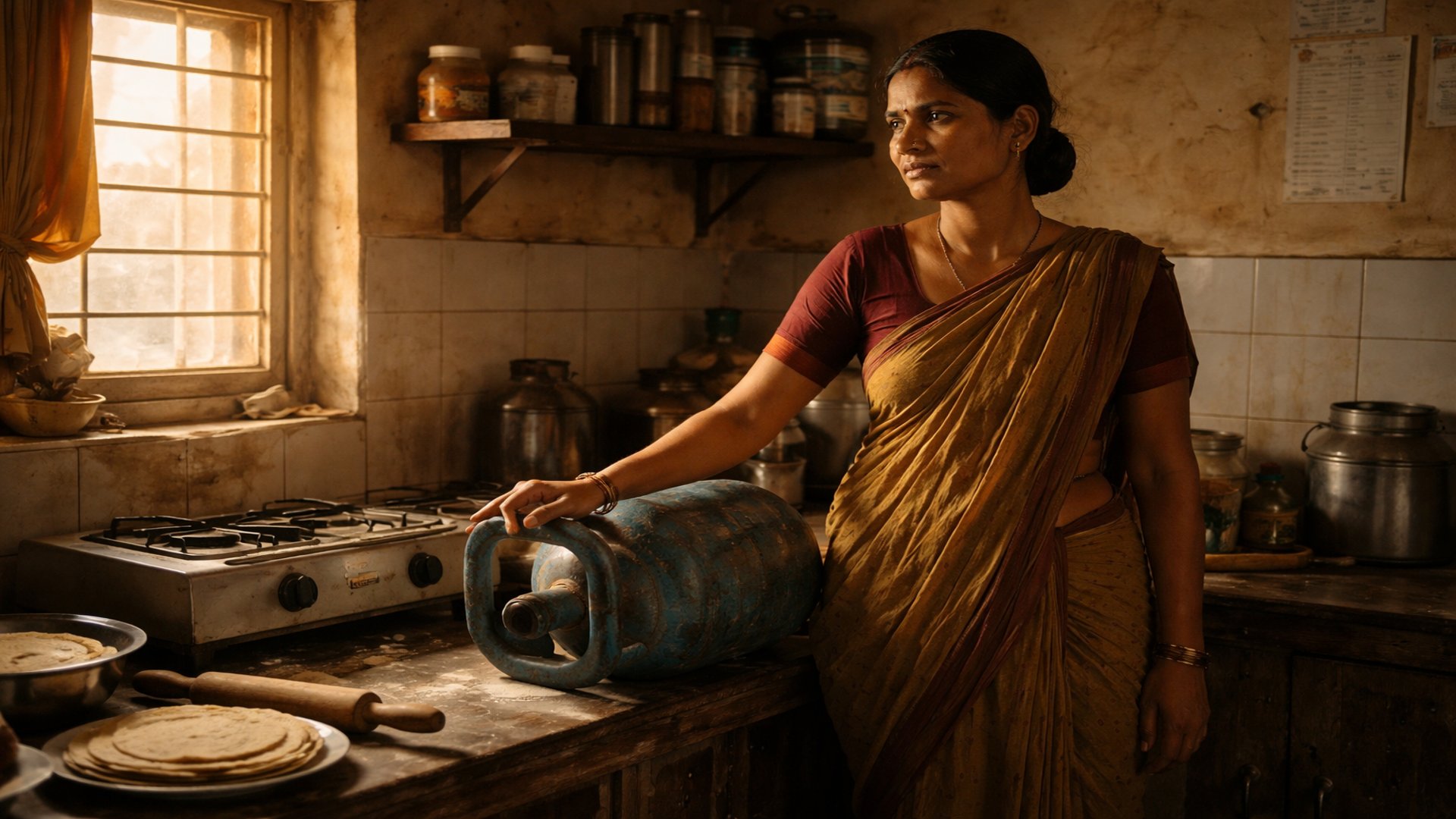
Sunita Devi woke up at 4 AM on a Tuesday.

Not because of the summer heat, not because of a crying child. She woke up because word had spread through the lanes of her Karnal neighbourhood the night before: the gas agency would have cylinders at dawn, first-come-first-served, and if you weren’t there early, you weren’t getting one.
She stood in that queue for three hours. She went home empty-handed.
Scenes like this are playing out with uncomfortable frequency across India in March 2026. The LPG shortage in India in 2026 is not just an energy issue. It is a household crisis. From the cramped chawls of Mumbai to the housing societies of Goa, from the restaurant kitchens of Bengaluru to the langar halls of Delhi’s gurdwaras, one question dominates everyday conversation: where has the gas gone?
This is a story of kitchens going quiet, of mothers relearning how to cook on borrowed wood, of restaurant owners watching years of hard work evaporate alongside their dwindling commercial cylinder reserves. It is a story about how a conflict thousands of kilometres away, can reach directly into the most intimate space of an Indian home: the kitchen. The cooking gas shortage affecting Indian households has exposed how closely energy security and daily life are connected.
What Is Actually Happening
To understand the LPG shortage, you need to understand one uncomfortable fact about India’s energy architecture: the country does not produce enough cooking gas for itself.
According to industry estimates and petroleum ministry data, India’s annual LPG consumption in the 2025–26 fiscal year has reached approximately 31.3 million metric tonnes. Yet domestic refineries, including the vast Jamnagar complex and state-run facilities in Kochi and Visakhapatnam, can only meet roughly 40% of that demand. The remaining 60% must be imported.
That dependence on imports has long been recognised as a structural challenge for India’s energy supply. What intensified the situation in early 2026 was rising geopolitical tension in the Persian Gulf.
The escalating conflict involving Iran, the United States, and wider regional powers has severely disrupted the Strait of Hormuz, the world’s most important energy corridor. Approximately 90% of India’s LPG imports normally transit this chokepoint. When shipping through Hormuz began to stall and cargo movements faltered, the ripple effect hit India’s bottling plants within days.
The government’s response was swift. The Essential Commodities Act was invoked. Domestic household supply was declared the highest priority. Refineries were directed to divert propane and butane back into the cooking gas pool, boosting domestic LPG output by approximately 25–30%. A new booking cycle rule was introduced, extending the minimum gap between refill bookings from 21 to 25 days, to prevent panic stockpiling and ensure more equitable distribution.
India also moved quickly to diversify sourcing. A 2.2 million metric tonne annual deal with the US Gulf Coast, representing about 10% of India’s import requirement had already been signed in late 2025 and is being accelerated. Additional shipments are being sought from Norway, Canada, and Russia.
Yet none of these measures are instant. A tanker from the US Gulf Coast takes roughly three weeks to reach an Indian port. The Middle East, by contrast, required only five days. That 15-day logistical gap, what analysts are calling the ‘Distance Penalty’ is the eye of the current storm.
City by City, Kitchen by Kitchen: The Human Cost
Statistics rarely convey what a crisis feels like. These stories do.
Delhi: When ₹800 Becomes ₹5,000
In East Delhi, long-standing resident welfare associations are documenting something deeply troubling. Cylinders that officially cost under ₹900 are being sold on the black market for ₹3,000 to ₹5,000. Families who cannot afford to pay are finding themselves cooking on electric induction stoves.
The Delhi Sikh community has raised the alarm specifically about langar operations that feed thousands of people daily at gurdwaras across the capital. Requests have been made directly to the petroleum ministry for priority allocation to keep these kitchens running.
Goa: A 25-Day Wait and Counting
Housing societies in Goa received circulated notices from estate management services warning residents of delays of up to 25 days for gas deliveries. ‘Vendors aren’t issuing cylinders,’ one notice read. ‘The situation might worsen. We advise all members to plan accordingly.’ For a state that draws millions of tourists who expect functioning restaurants and guesthouses, the timing could not be worse.
Bengaluru and Chennai: Restaurants on the Brink
In both cities, restaurant associations have issued stark warnings. Nearly 50% of eateries risk being forced to temporarily shut down as commercial reserves run dry. The commercial LPG segment is bearing the brunt of supply tightening, because the government has rightly prioritised household supply first.
The problem is that commercial LPG scarcity creates a second-order effect that reaches households anyway. When restaurants struggle, people eating out get affected. When tiffin services shut, working families lose affordable meal options. When street vendors can’t cook, daily wage labourers lose an affordable meal. The commercial crisis is quietly becoming a food security issue.
Andhra Pradesh: Down to One Day’s Supply
Hotel owners in several Andhra Pradesh districts report that cylinder availability has dropped by 40–50%, and that some establishments are operating on just a day’s worth of reserves.
Kolkata and West Bengal: Auto-LPG Queues and Rising Prices
Auto-rickshaw drivers queuing at LPG dispensing stations in Kolkata are reporting price increases of roughly ₹5 per kg, but drivers say the uncertainty over availability is a larger concern than the price hike itself. When the fuel that runs your livelihood may not be available tomorrow, no price increase matters quite as much as that unpredictability.
The Bigger Picture: 332 Million Connections and a Chokepoint
India has approximately 332.1 million active domestic LPG connections. Of these, about 104.29 million are under the Pradhan Mantri Ujjwala Yojana (PMUY), a landmark welfare programme that brought clean cooking fuel to India’s poorest households, replacing wood, coal, and dung cakes that caused respiratory disease and pollution.
One important consequence of the expansion of LPG access is that India’s decade-long success in expanding clean cooking access has also dramatically deepened its vulnerability to external shocks. Every family that moved from firewood to LPG became, inadvertently, dependent on a sea lane 3,000 kilometres away.
For PMUY beneficiaries in rural Rajasthan, families in the plains of Bihar, first-generation LPG users in tribal Jharkhand, the crisis is disproportionately cruel. They are least equipped to absorb sudden price spikes, least likely to have alternative cooking equipment, and most likely to revert to biomass fuels whose health costs are invisible but very real.
One study estimated that household air pollution from solid-fuel cooking contributes to over 600,000 premature deaths in India annually. Every time an LPG shortage pushes a rural family back toward a chulha, that statistic inches higher.
The Black Market
Every major shortage creates an opportunity for exploitation, and this crisis is no different.
Reports from across the country describe dealers demanding extra payments before releasing cylinders, cylinders being diverted to those who pay cash premiums, and commercial cylinders being split and sold in smaller portions at inflated rates. The Essential Commodities Act, now invoked by the government, carries penalties of up to seven years in prison for hoarding. But enforcement is patchy, and in areas where supply is critically low, desperation often overrides the rule book.
There is something particularly distressing about the black market dynamic in the context of food. The act of cooking is not a luxury that can be deferred. When the basic infrastructure of daily nourishment is monetised by those who control supply, what is at stake is not just money. It is dignity.
What You Can Do Right Now: A Practical Guide
If you are navigating the shortage as a household or small business owner, here is what the government and consumer protection experts advise:
For Households
- Book your refill as early as your 25-day window opens. Use the missed-call facility (IOCL: 8454955555, BPCL: 7715012345, HPCL: 9222201122) network data suggests this currently has a higher success rate than apps or IVR.
- Pay only the official rate. Never pay extra for ‘faster delivery.’ It is illegal, and it worsens local shortages.
- Save your booking receipt and consumer number every time.
- If your cylinder is overdue or overpriced, escalate: first to your distributor, then to the oil marketing company’s consumer helpline, then to the CPGRAMS/PG Portal at pgportal.gov.in.
- Ensure your Aadhaar is linked to your LPG connection to receive the PMUY subsidy of ₹300 per cylinder.
For Commercial Users
- Commercial LPG supply is tighter than household supply and the government is legally required to prioritise domestic use. Plan your reserves with that in mind.
- Contact your state-level petroleum authority for any announced relief windows for the hospitality sector.
- Consider temporary alternatives: commercial induction equipment, commercial electric pressure cookers, or registered biomass gasifier systems where available.
Interim Cooking Alternatives for Households
- Induction cooktops: Widely available, efficient, and can handle most everyday cooking tasks. Sales have surged nationally so buy early before stock tightens further.
- Electric pressure cookers and rice cookers: Ideal for dal, rice, sabzis, and soups.
- Microwave ovens: Useful for reheating and quick preparations.
- No-cook meals: Salads, curd-based dishes, overnight oats, and fruit bowls can bridge short gaps without any fuel.
The Road Ahead: Can India Fix Its Cooking Energy Vulnerability?
The immediate crisis will likely ease. The US LPG shipments will arrive. Hormuz tensions may reduce. Domestic production boosts will partially compensate. The government’s 10-day buffer stock, while thin, is being managed carefully.
But the deeper question is whether India will use this moment to rethink its long-term cooking energy architecture. Several paths forward are worth considering.
Piped Natural Gas (PNG) expansion into Tier 2 and Tier 3 cities would reduce household dependence on cylinder logistics entirely. PNG supply is more resilient to import disruptions because storage and pipeline infrastructure can buffer short-term shocks. The government’s City Gas Distribution network needs accelerated investment.
Electric cooking via induction and infrared stoves represents the most durable long-term solution for a country adding solar capacity at record pace. India’s 143.6 GW of cumulative solar capacity means that clean electricity for cooking is increasingly viable. A targeted subsidy for induction stoves — especially for PMUY beneficiaries — could reduce LPG dependence faster than any import deal.
Compressed Biogas (CBG) plants can convert agricultural waste into cooking fuel for rural households, providing a locally produced, weather-resilient alternative. Scaling this programme would address both cooking energy and crop-stubble burning simultaneously. As of today, India has 195 CBG plants in various stages of development.
Strategic LPG reserves: India currently holds roughly 10 days of LPG buffer stock. For comparison, the International Energy Agency recommends 90 days of strategic petroleum reserves for oil. Building dedicated LPG storage would significantly reduce vulnerability in the future.
The 2026 crisis is, in a painful sense, an education. It is showing India what energy insecurity actually feels like when it arrives not at a petrol pump, but at the kitchen stove.
The Soul of the Story: What This Crisis Reveals About Us
There is a tendency, in energy policy discussions, to speak in metric tonnes and import percentages and geopolitical chokepoints. These numbers matter. But they can also obscure the human reality that every one of those metrics represents.
Behind every cylinder that didn’t arrive is a mother who had to explain to her child why dinner would be late. Behind every black-market premium is a small business owner doing cold calculations about whether to pay ₹4,000 for a ₹2,100 cylinder or shutter the shop their family has run for twenty years. Behind every gurdwara’s urgent letter to the petroleum ministry is a community that has pledged to feed strangers regardless of circumstance, now wondering if it can keep that promise.
India’s relationship with cooking fire is ancient and intimate. The hearth has been the centre of domestic life for millennia. The LPG cylinder, for all its modernity, slotted into this ancient relationship seamlessly. It became the clean, convenient keeper of the flame.
When that flame is threatened, what is threatened is not just caloric intake. It is the texture of daily life itself.
At Story of Souls, we believe that the stories worth telling are often the ones hiding inside the headlines — the ones that reveal what a policy decision or a geopolitical event actually means for the person standing in a queue at 4 AM, cylinder booking receipt in hand.
Sunita Devi went home empty-handed that morning.
Tomorrow, she will return to the queue again, like thousands of others across the country, holding on to the quiet belief that the flame will come back.
FAQs: Your Questions About India’s LPG Shortage Answered
Q: Is there a complete LPG shutdown in India?
A: No. The government has confirmed there is no complete shutdown. The crisis manifests as delivery delays, extended booking cycles, price pressure, and acute shortages in the commercial segment. Household supply is being prioritised under the Essential Commodities Act.
Q: Why has the booking gap been extended to 25 days?
A: The government extended the minimum gap between LPG bookings from 21 to 25 days to prevent panic-buying and phantom demand, situations where households book new cylinders while their current ones are still partially full. The measure is designed to ensure more equitable distribution during supply tightness.
Q: What is the current official LPG price in India?
A: As of March 2026, the official rate for a standard 14.2 kg domestic cylinder is approximately ₹913, with variations by city. PMUY beneficiaries receive a subsidy of ₹300 per cylinder credited via Direct Benefit Transfer. If you are being asked to pay significantly above the official rate, that is illegal.
Q: Why is commercial LPG more affected than household LPG?
A: By law and by government policy, domestic household supply is prioritised during supply disruptions. Commercial users including restaurants, hotels, caterers are asked to absorb the shortfall first. This protects home kitchens but puts significant pressure on the food service industry.
Q: How long is the crisis expected to last?
A: Energy analysts suggest the acute phase may ease over the next 4–8 weeks as alternative import shipments from the US, Norway, and Canada begin arriving. However, full normalisation depends significantly on whether the geopolitical situation in the Middle East stabilises and Hormuz shipping resumes at normal capacity.
Q: What should I do if my dealer is overcharging me?
A: Document the overcharging by getting a receipt, note the amount, and record the date. Report to your oil marketing company’s consumer helpline (IOCL: 1800-2333-555, BPCL: 1800-22-4344, HPCL: 1800-2333-555). If unresolved, escalate to the CPGRAMS portal at pgportal.gov.in. Dealers found overcharging face serious legal penalties.
A Note from Story of Souls
This piece was researched and written in March 2026, during the acute phase of the LPG supply disruption. Data and official statements referenced here reflect conditions as of March 13–14, 2026.
If you are personally experiencing difficulties with LPG supply, we invite you to share it with us at Story of Souls. Your voice is the reason we write.
Our Storyteller: Alifia Olia

Alifia Olia calls Mumbai home, and Mumbai, in many ways, has shaped everything she writes.
A senior ad copywriter with years spent crafting language for some of the city’s leading agencies, Alifia brings to Story of Souls an unhurried truth. As Co-founder of the platform, she has been part of building a space where ordinary people find their stories taken seriously and written about with care.
History was her first passion. That love for the past taught her something that stays with her today: that the present is always being written, and someone needs to be paying close attention.
She writes about people who persist, cities that breathe and struggle and things that we often overlook. Her features span empowerment, current affairs, and culture.
When she is not writing, she is travelling; not to destinations, but towards people. She loves meeting strangers as much as spending time in nature.
At Story of Souls, Alifia believes what the platform has always believed: that if you want to truly know someone, you must know their story first.
About Story of Souls
Leave your comments on how you like this story. If you love it, share it to bring that change we wish to see in the world.
You can also share your inspiring story with us at submitstories.storyofsouls@gmail.com. Story of Souls is an initiative where we invite people to bring their stories to us. We want people to “write to heal.” The idea of Storyofsouls is appreciated by ALL INDIA RADIO. An Online Platform where you can share your real-life stories. The impact of our stories has reached the UN and Harvard University. For some real-life stories, web series are also planned. You can also visit our YouTube channel. You can follow us on Facebook LinkedIn Instagram.
Storyofsouls is glad to inform you that we are now a Google News-verified platform.
We are proud to inform you all that storyofsouls.com is the official TEDx MotiJheel Kanpur Partner for their upcoming event.