


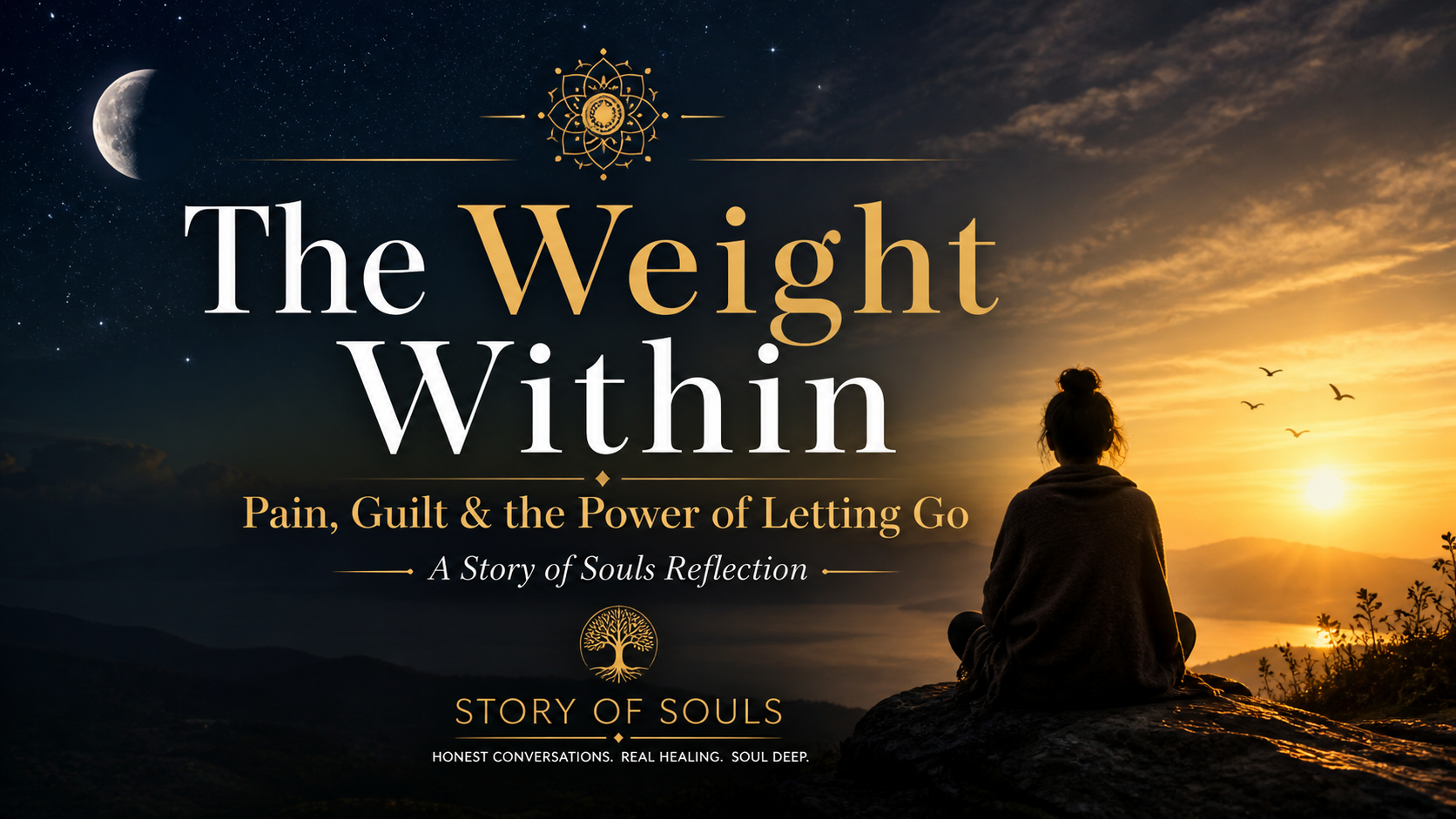
Where Does the Pain Come From?
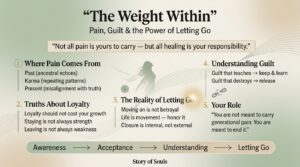
Emotional pain often comes from past experiences, unresolved patterns, and present misalignment — but healing begins the moment you understand and release it.

There are moments in life when you sit quietly — perhaps in the blue hour between night and morning, perhaps in the middle of a crowd — and you feel it. A dull, steady ache that has no name. A heaviness that doesn’t announce itself but simply is. And you wonder: where did all of this come from?
The honest answer is: we don’t always know.
Some of our pain arrives through the invisible threads of lineage — the unspoken sorrows of parents who never learned to grieve, the unexpressed rages of grandparents who survived things they never spoke of aloud. This is what we now understand as generational or ancestral trauma: pain that does not die with the person who first felt it, but travels forward through bloodlines and nervous systems, looking for someone willing to finally feel it fully enough to let it go.
Some pain is karmic — shaped by the cumulative weight of past choices, past lives, past selves we no longer remember but whose echoes we still carry. There is a kind of reckoning that happens not as punishment, but as completion — the universe offering us, again and again, what remains unresolved.
And some pain, the kind that sneaks up on us most quietly, is self-manifested. It is born from the distance between who we are and who we believe we should be. From the gap between the life we’re living and the one we can feel, somewhere deep inside, we were meant to live.
None of these origins make the pain less real. But understanding where it may have come from is the first small step toward choosing what to do with it.
The Beautiful Trap of Loyalty
Here is one of the most complicated, quietly devastating ways pain enters a life: through the virtue of loyalty.
We are taught, from the time we are small, that loyalty is sacred. And it is. It speaks to something true and ancient in us — the instinct to protect what we love, to honour what we have been given, to stay.
But here is what no one tells you clearly enough: loyalty without reciprocity is not loyalty. It is self-erasure.
There are relationships — with people, with places, with communities, with work — where we stay out of loyalty long past the point where staying is serving us. We tell ourselves it is the right thing. We tell ourselves this is who we are: someone who does not abandon. And yet, quietly, something in us is diminishing. We are not growing. We are not seen. Our love is not being returned in kind. Our presence has stopped being valued and started being assumed.
This is the peculiar cruelty of misplaced loyalty: it can cost you your growth, your self-respect, your sense of direction — and still leave you feeling as though you are the one who has done something wrong by noticing.
Stagnation, too, is a form of suffering. And the universe, life itself, was not designed for stagnation. Look at everything around you — the breath moves in and out, the seasons turn, the cells in your body are constantly dying and renewing, the stars are in motion. Everything is moving. And if life insists on movement, perhaps the most life-aligned thing we can do is move too — not recklessly, not without grief, but with intention and courage.
To outgrow something is not a betrayal. It is biology. It is the soul doing what souls were made to do.
Moving On Is Not Abandonment
There is a particular guilt that haunts those of us who finally choose to leave — a relationship, a role, a place — even when the leaving is clearly right. We wonder: am I being selfish? Am I being disloyal? Have I hurt someone who depended on me?
Sometimes, yes. Sometimes choosing yourself does create rupture. And that is a real cost that deserves to be honoured, not dismissed.
But here is the important distinction: choosing to move forward is not the same as not caring. You can love someone and also know that staying is slowly destroying you both. You can honour a chapter of your life as significant and also recognise that the chapter has ended.
Our breaths are numbered. Our time on this earth is finite. That is not a morbid thought — it is a clarifying one. If everything is moving — time, age, seasons, the very rotation of the earth — then remaining frozen out of fear or guilt is not loyalty. It is simply fear wearing loyalty’s clothes.
When you choose to move on, you do not owe that person or place a speech. You do not always have the opportunity to explain. But you do owe yourself and that relationship something: an honest, interior reckoning. A quiet acknowledgement of what it meant. A sincere wish for their wellbeing. And then, the hardest part — the release.
The Practice of Release
There is something profound in the idea that you do not always need to speak something aloud to someone directly in order for it to be released.
Many of us carry things we cannot say. Things unsaid to people who are no longer in our lives, or who would not be ready to receive them, or who have already passed. Words of love that never came out in time. Apologies that were never spoken. Gratitude that was felt but swallowed. Grief that was never given air.
The universe is listening. Not in a magical thinking way — but in the deeply human way that what we hold inside us shapes us, and what we release changes us.
You can speak to the moon. You can write a letter you never send. You can sit in silence and simply mean it — feel the words forming in your chest, feel the weight of them, and then consciously, with full sincerity, let them go. Offer them up to whatever you believe in — the universe, the divine, the vastness of existence that holds all things.
“I’m sorry. I was wrong. I did not know then what I know now. I release this.”
“I loved you. I still do. But I had to go. Forgive me if I hurt you.”
“I could not be there when you needed me. That is one of my deepest regrets. I’m sorry. I release the guilt.”
These acts of interior honesty — done with genuine feeling, not ritual performance — have the capacity to lighten something that nothing else can reach.
On Guilt That Belongs to You — and Guilt That Doesn’t
There is a difference between guilt that is instructive and guilt that is corrosive.
Instructive guilt tells you: this is something you did that caused harm. Pay attention. Learn. Make amends where you can. Do better.
Corrosive guilt tells you: you are fundamentally bad. You don’t deserve to be free of this. You must carry this forever.
The first is useful. It is the conscience doing its job. The second is punishment without end, and it serves no one — not you, not the person you wronged, not the world.
We make decisions in moments. Every decision we make is made with the information, the awareness, the emotional resources, and the circumstances we had at that time. You cannot go back. You cannot unmake the past. What you can do — the only thing you can do — is be honest now, make right what can be made right, genuinely wish wellbeing to those you have hurt, and then let yourself be free.
This is not excusing harm. This is understanding that human beings are works in progress, and that carrying permanent guilt does not make us better people. It makes us heavy, contracted, unable to be fully present or fully loving. And heavy people cause more hurt, not less.
Releasing the Inherited
Beyond our personal guilts and griefs, there is something older we carry.
Our parents’ unresolved heartbreaks. Our grandparents’ silences. The cultural and communal wounds of the land we come from. These are not ours to carry forever — they were passed to us unconsciously, not as a life sentence but as an invitation: be the one who finally heals this. Be the one who transforms what was handed down in pain into something that goes forward in peace.
You can do this work in meditation, in therapy, in prayer, in honest conversation, in creative expression, in tears cried fully and completely until they are done. You can consciously choose — on behalf of your lineage, as a gift to those who come after — to release what was given to you without your consent.
I release what is not mine to carry. I honour what you went through. And I choose to carry it no further.
The Sincerity Requirement
Here is the part that cannot be skipped or rushed.
None of this — the release, the apology to the universe, the letting go — works if it is done as performance. If you say the words without feeling them. If you go through the motions to check a spiritual box. If you release a thing on Monday and quietly pick it back up by Thursday because some part of you isn’t really ready yet.
Genuine release requires:
Knowing — being able to clearly see what you did, what happened, what was lost or hurt. Not in self-flagellation, but in honest clarity.
Accepting — allowing the truth of it to exist, without minimising or catastrophising. Yes, this happened. Yes, it mattered. Yes, I played a part.
Understanding — discerning whether the harm was intentional or unintentional, whether you were unconscious or unkind or simply human and limited. Both can cause pain. Neither is necessarily a sentence.
Releasing with sincerity — choosing, with your whole self, to put this down. Not to forget. Not to pretend it didn’t happen. But to stop carrying it.
When all four are genuinely present, something shifts. Not always immediately. Not always dramatically. But something in you changes — becomes quieter, becomes clearer, becomes lighter.
And when you are lighter, you have more to give. You make different choices. You are less likely to repeat the patterns that caused the pain in the first place. Because healing is not just about the past — it is about who you become when you are no longer weighted down by it.
An Invitation
If you are reading this and you feel something stirring — a grief you haven’t named, a guilt you’ve been carrying quietly, a loyalty that has cost you more than it has given — perhaps this is your moment.
You don’t need a ritual. You don’t need a ceremony. You don’t need anyone’s permission.
Find a quiet space. Feel what is there. Name it, as honestly as you can. Wish the person or situation wellbeing, from the truest part of yourself. And then — gently, completely — release it.
Let the universe receive it. Let the moon hold it. Let time do what time does.
You are allowed to be free. Not because your pain was small, or because you were always right, or because nothing you ever did caused harm. But because freedom — from guilt, from stagnation, from patterns that no longer serve — is what makes space for something better to come.
The soul was made to move. Let yours.
Story of Souls is a space for honest conversations about the interior life — the grief we carry, the growth we reach for, and the quiet revolutions happening inside ordinary human hearts.















A thoughtful read on ancestral trauma healing. Understanding inherited emotional patterns and breaking generational cycles is essential for personal growth, emotional balance, and long-term healing journeys. – https://resonatinginnocence.com/ancestral-trauma-healing-pattern-explained/
The way you’ve expressed ancestral trauma healing is deeply insightful—especially the emphasis on inherited emotional patterns and breaking cycles. It reflects real awareness and sensitivity toward long-term healing.
You have remarked very interesting points! ps decent web site.