

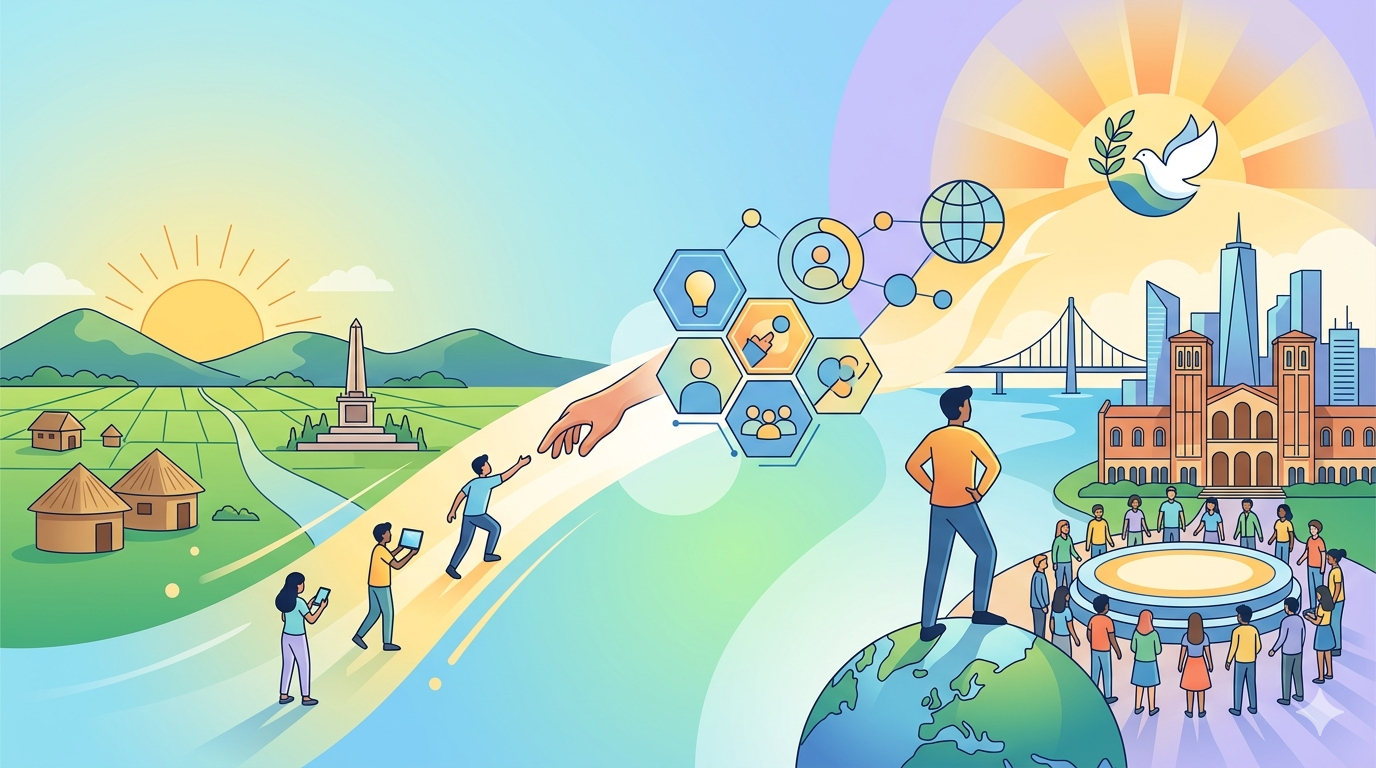
The world is buzzing with digital opportunities. Startup ecosystems, mentorship networks, global conferences, online fellowships — for those in India’s metropolitan centres, these have become part of the everyday landscape. Yet travel a few hundred kilometres inward, past the highway noise and into the quieter interiors of Bihar, and a different reality emerges. Here, in the small towns and rural stretches that rarely make the news, talented young people wake up every morning to a world that simply does not know they exist — and more painfully, a world they do not yet know how to reach.


This is not a story about that gap. This is a story about one young man who decided to close it.
Raushan Singh grew up in West Champaran — a district in Bihar perhaps best known as the land where Mahatma Gandhi launched the Champaran Satyagraha in 1917. It is a place with deep historical roots and immense human potential, yet, like much of rural Bihar, it has struggled with limited infrastructure, scarce professional guidance, and a persistent shortage of exposure to the wider world. For a generation of young people here, ambition often quietly dims not from lack of intelligence or drive, but simply from not knowing what doors exist and how to knock on them.
Raushan was one of those young people. And then — he wasn’t.
The Making of a Mission
Like most meaningful journeys, Raushan’s did not begin with a grand blueprint. It began with a feeling — a quiet, persistent frustration at watching peers with genuine ability fall through the cracks, not because they lacked potential, but because they lacked access. He himself had experienced it firsthand: the absence of mentorship, the invisibility of professional networks, the financial constraints that forced choices no young person should have to make, and the strange social pressure that discourages dreaming beyond what is familiar.
Most people in that position accept these conditions as facts of life. Raushan chose to treat them as problems to be solved.
He founded Digital HelpingHand — a youth-driven initiative that, in its earliest days, looked like little more than a social media page sharing information. Scholarship announcements. Fellowship deadlines. Internship openings. Competition details. Small, practical nuggets of awareness that could shift a young person’s trajectory if they arrived at the right moment. It was not glamorous work. But it was needed work.
“The purpose was never only financial growth,” Raushan reflects. “It was always about creating meaningful impact and building a supportive ecosystem for youth.” The community, the startup network, the events — these may be buzzwords in metros like Delhi or Bengaluru, but in Tier 2 cities and rural areas, they remain rare and precious. Digital HelpingHand set out to change that equation, one opportunity at a time.
Building in the Dark
The story of building something from nothing is rarely told in its full, unglamorous truth. There is a version of entrepreneurship that is celebrated in pitch decks and panel discussions — the vision, the growth curve, the applause. What is less often spoken about is the grinding reality of doing it with limited money, without a support system that believes in you, and without any guarantee that it will work at all.
Raushan navigated all of it. In the early stages, he managed everything independently — operations, promotions, community management, content creation, event organisation, and outreach — often simultaneously, with minimal resources. There were no investors, no team, no institutional backing. There was only the mission.
The scepticism from those around him added another layer of difficulty. Many people doubted the vision in those early days. When you are building something that does not yet have a clear precedent in your community, earning trust is slow, painstaking work. It requires showing up consistently, transparently, and without giving in to the temptation of shortcuts.
There were also the quieter battles — the kind that do not make it into motivational speeches but are perhaps the most defining. Burnout. Rejection. The particular loneliness of working on something that not enough people yet understand. “There were moments of burnout, rejection, and uncertainty,” Raushan acknowledges. “However, the positive impact on people kept the mission alive.”
That is not a small thing to say. Impact, when it is real and visible — when a student you helped discovers a scholarship they would have missed, or a young creator finds their first platform through you — becomes fuel. It becomes the reason to continue on the days when every other reason has temporarily run out.
Growing an Ecosystem
Over time, Digital HelpingHand evolved well beyond a social media awareness page. It grew into a multifaceted platform offering social impact programmes, volunteering opportunities, open mic and creative events, digital awareness campaigns, skill development support, community collaborations, and broader youth empowerment initiatives.
What Raushan was quietly building, without necessarily using the vocabulary of it, was an ecosystem — the kind that the metros take for granted and that smaller towns desperately need. A space where young people feel seen. Where someone is actively working to ensure that geography and socioeconomic background do not become the deciding factors in a person’s future.

The platform connected with students, creators, volunteers, and aspiring changemakers across different regions of India. Its community grew organically — not through advertising or manufactured visibility, but through the reliable currency of genuine usefulness. People recommended it because it had helped them. They shared it because they wanted others to experience the same shift in possibility.
The feedback that came back was consistent: the platform motivated people, helped them find opportunities, and gave them confidence. That last part matters enormously. In communities where systemic neglect has historically communicated to young people that they are not meant for certain rooms, confidence is not a soft outcome — it is a prerequisite for everything else.
A Call from the World Stage
In 2026, the work that had quietly accumulated over years of consistent effort received its most significant external recognition yet. Raushan Singh was selected as an Independent Candidate to represent India at the 13th International Youth Conference (IYC13), scheduled to take place from May 21–24, 2026, at UCLA in Los Angeles, USA.
Organised by the International Organization of Youth, IYC13 brings together young leaders, changemakers, diplomats, and policymakers from across the world. The theme of this year’s conference — “Innovative Diplomacy: Youth Advancing Peace and Security” — reflects a global recognition that the next generation must be at the centre of conversations about how humanity navigates its most pressing challenges.
For a young man from West Champaran — a place that rarely generates headlines of this kind — the selection is extraordinary. It is not merely a personal milestone; it is a statement about what becomes possible when someone refuses to be limited by their circumstances.
Raushan sees the conference as an opportunity to carry India’s youth perspectives onto a platform where they can engage with global leaders, learn from international models of social change, and forge collaborations that may eventually find their way back to the communities that need them most. The world has things to teach Bihar. And Bihar, through the voice of this young man, may have a few things to teach the world.
What the Journey Means
It would be easy to read Raushan’s story as a neat narrative of triumph over adversity — a motivational arc with a satisfying destination. But that reading would miss something important. The most significant part of this story is not the international conference. It is the years that came before it: the anonymous, unglamorous, deeply necessary work of showing up for his community without any guarantee of external reward.
The vision he holds for Digital HelpingHand’s future is expansive: expanding youth programmes across India, launching structured mentorship initiatives, organising larger community impact events, building collaborations with organisations and institutions, creating digital learning resources, and developing a stronger volunteer network. None of this is small. All of it is necessary.
What Raushan Singh has demonstrated is something that young people in small towns across India — and indeed across the world — need to see demonstrated: that it is possible to begin with very little and build something that genuinely matters. That the absence of a support system is not a permanent condition but a challenge to be met with the determination to create one. That local action, pursued with consistency and care, can have consequences that reach far beyond the local.
A Message That Travels
As Raushan Singh prepares to walk into a conference room in Los Angeles — representing not just himself, but every young person in Bihar who ever wondered if someone in a faraway room was thinking about their future — his message to the youth around him remains grounded in the same truth he discovered through years of doing the work:
“Believe in yourself, stay committed to your purpose, and never stop working to create positive change — your efforts can take you farther than you imagine.”
From West Champaran to UCLA — and, eventually, back to the communities that made him. That is the arc of a life lived in service. That is the story of Raushan Singh.
Published by Story of Souls