

What are the real benefits of mindful walking without headphones?
Walking without headphones or screens — especially in your 40s — promotes mental clarity, emotional introspection, and heightened environmental awareness. It counteracts dopamine dependency caused by social media scrolling, restores unstructured thought, and creates natural opportunities for genuine human connection. Unlike gym-based fitness, mindful walking integrates physical health with mental presence, making it one of the most accessible wellness practices available.
How Walking in Your 40s Changes More Than Your Waistline
It began simply enough. A decision, almost unremarkable: to walk more. The motivations were practical — a slimmer waistline, a fitter body, the quiet vanity of looking better as the forties arrived. Nothing unusual there. Millions make this resolution every year, lace up their shoes, and step out the door.
But something unexpected happened on the way to fitness. The act of slowing down — of placing one deliberate foot in front of the other — began to open a door not to the outside world, but inward. What started as a health habit became something far more unsettling and far more necessary: an act of witnessing.
Research consistently shows that walking for mental health offers benefits well beyond the cardiovascular. It reduces cortisol, clears cognitive fog, and — crucially — creates space for the kind of reflective thinking that the pace of modern life systematically eliminates. This is that story.
Seeing the World Clearly: What Slow Walking Reveals
When you walk slowly enough to actually see, the world reveals itself in ways that running through life on autopilot never allows. The streets are chaotic — people navigating calls mid-stride, others wandering without seeming to know or care where they are going. Traffic horns do not merely honk; they pierce, they assault, they fill the air like a relentless argument between machines.
Noise pollution in urban environments has been linked to elevated stress hormones, disrupted sleep, and reduced cognitive performance. But you don’t need a study to feel it. You just need to walk quietly enough, for long enough, to notice how loudly the world is screaming.
And then, mid-step, the question arrived with quiet force: Was the world always like this?
Or have we simply stopped noticing — too consumed with checking whether the car door is locked, scanning missed messages, mentally fast-forwarding to the next task — to see what is right in front of us?
“Was the world always this loud, this frantic — or have we simply stopped noticing because we stopped looking?”
The Inconvenient Truth: We Are Part of the Problem
Here is the uncomfortable part — the thought that stops you cold, mid-stride, with one foot still in the air. The noise, the chaos, the indifference: we are not merely observers of it. We are contributors. Every unnecessary horn pressed in frustration. Every call taken while crossing a road. Every moment of distracted driving. We do these things and then, in the very next breath, lament the state of the world.
The hypocrisy is not comfortable to sit with. We hate the world we are actively building. We criticise the noise we add to. We mourn the loss of human connection in the digital age while scrolling past the humans in our own homes.
This is not a moral judgement. It is simply an observation — the kind that only becomes possible when you are moving slowly enough to catch yourself in the act.
The Step Counter Trap: When Wellness Becomes Performance
The shift from busy roads to quieter morning streets brought its own revelation. Even in the calm, the earphones were in. The step counters were running. Eyes were fixed not on the world, but on the glow of a wrist-worn screen. Everyone — including, with a jolt of recognition, the person observing all of this — was performing fitness rather than simply living it.
We have traded the experience of being alive for its quantification. Ten thousand steps. Heart rate zone two. Calories burned. The body moves, but the mind is elsewhere — in the data, in the metric, in the number that will later be posted or privately admired.
This is screen addiction in its most socially acceptable form. The device is not the phone in our pocket — it is strapped to our wrist, counting our every move, monetising our most private biological rhythms.
“We trust technology more, perhaps, because it never judges us. It simply obeys — and in that obedience, quietly, it begins to command.”
Dopamine, Social Media, and the Collapse of Real Human Connection
Gadgets, it turns out, do not merely assist us. They obey us — and in that obedience, they feed something we rarely examine: the need to feel in control, to feel seen, to feel validated. The dopamine hit that once came from a real conversation — from genuine laughter, from eye contact with another human being — has been quietly outsourced to a notification. A like. A streak.
Neuroscience has confirmed what daily life already demonstrates: social media platforms are engineered to exploit the brain’s reward system. Each scroll, each notification, each algorithmically timed burst of content is designed to generate a dopamine response and bring you back for more. The result is a population that is simultaneously more connected and more profoundly lonely than at any point in history.
We fear other humans, at least partly, because other humans now have the tools to preserve and weaponise our most unguarded moments. The phone is not just a gadget. It is a court that is always in session.
What Life Looked Like Before the Screen: A Personal Comparison
There is a specific memory that keeps returning on these walks: the way time worked when we were young. The agreement to meet at a place, at a rough hour, with no way to confirm or cancel. And yet — people arrived. Not always punctually, but they arrived, because the meeting itself mattered enough.
No one was distracted by a device, because there was no device. Attention was not divided between the present moment and an infinite elsewhere. Conversations happened in full — not half-listened to while the other eye drifted to a screen. We were, in the most basic sense, present.
The tragedy is not that technology arrived. The tragedy is that we handed it everything — including the parts of ourselves that did not need to go.
Are We Human or Humo-Robots? The Automation of Daily Life
Are we walking — or are we executing a pre-programmed routine? Wake to an alarm set by a device. Check the device before speaking to anyone in the home. Commute with ears sealed by earphones. Work in front of screens. Scroll during meals. Sleep with the device on the nightstand, its light still blinking.
The day is automated, and we have automated it ourselves. The gadgets follow our commands, yes — but only because we have already been programmed by them. The alarm, the notification, the recommended video: these are not interruptions to our lives. They have become the structure of our lives.
What reality are we building inside ourselves — one screen, one scroll, one dopamine spike at a time?
The Mindful Walking Practice That Changed Everything
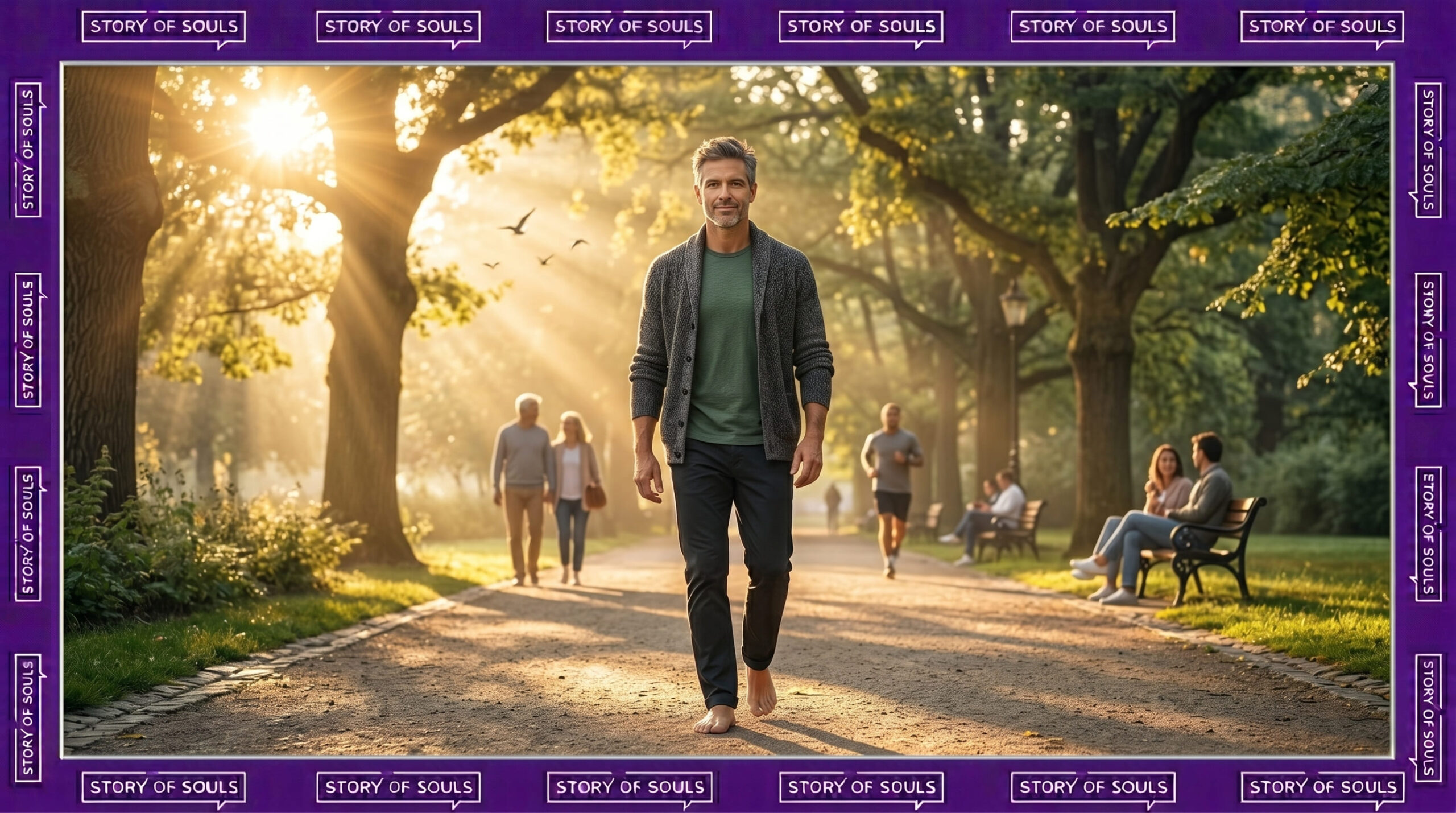
And yet — the walk continues. Because it turns out that walking, at its best, is not primarily a physical act. It is a practice of presence. Moving the body through space, without earphones, without a screen, without a destination beyond the walk itself, creates the conditions for something increasingly rare: unstructured thought.
The introspective habit that belonged to the teenage years — the long, uninterrupted thinking that formed opinions, processed emotions, and built a sense of self — returns, almost shyly, on these mornings. Thoughts that have been waiting in queue behind the noise of daily life finally get their turn.
Occasionally, on these quieter routes, there is an encounter with someone who is also not on their phone. A brief, unguarded exchange — about health, about life, about nothing in particular. These conversations, small as they are, feel like water after a long thirst. Proof that the capacity for genuine human contact has not disappeared; it has merely been waiting for an opening.
“The walk does not solve the world. It solves something smaller and more essential: it returns you to yourself.”
Conclusion: Walking as a Form of Reclaiming Your Life
This is not a manifesto against technology. It is not a call to dismantle devices or retreat from the modern world. It is something quieter and more personal: a record of what becomes visible when you slow down enough to actually look.
Twenty-odd years ago, there were walks too. But they were walked differently — without the weight of knowing what was being lost. Now, with that knowledge, the walk changes. Each step is a small, deliberate reclamation. Of attention. Of thought. Of the quiet, unmonitored, unquantified, beautifully inefficient act of simply being a human being.
The world may not change because of it. But the person walking through it might.
— Written in the forties, on a morning walk, somewhere between the noise and the quiet —
FAQ SECTION (AEO — FAQPage Schema)
Paste these Q&As verbatim into your FAQPage JSON-LD schema. Each answer targets AI Overviews, voice search, and featured snippets.
Q1: What are the mental health benefits of walking without headphones?
Walking without headphones allows the brain to enter open-ended thinking, similar to meditation. Without audio stimulation, the default mode network — responsible for introspection, self-reflection, and creative problem-solving — becomes more active. Studies show this improves mood, reduces anxiety, and strengthens personal identity. It also heightens environmental awareness, making the walker more present and engaged with the physical world.
Q2: Why do people feel more disconnected despite being more digitally connected?
Digital connectivity creates the illusion of social engagement while replacing the depth of in-person interaction with shallow, algorithmically mediated exchanges. Social media platforms exploit the brain’s reward system to maximise screen time. Over time, this conditions the brain to prefer quick digital rewards over the slower, richer payoff of real human conversation — producing a paradox of loneliness within hyper-connectivity.
Q3: How does social media affect dopamine levels in the brain?
Social media platforms trigger dopamine release through unpredictable reward cycles — a mechanism similar to slot machines. Each refresh or notification creates a small dopamine spike in the brain’s reward centre, reinforcing compulsive checking behaviour. Over time, the brain becomes desensitised, requiring more stimulation for the same response — reducing motivation, impairing focus, and increasing anxiety and low mood.
Q4: What is a digital detox and does it actually work?
A digital detox is a deliberate period of reduced screen use to allow the mind to reset. Evidence suggests even short-term detoxes — as brief as one week of reduced social media — can significantly lower anxiety, improve sleep quality, and increase wellbeing. A sustainable detox does not require complete abstinence; creating screen-free time windows, particularly during mornings and outdoor activities, is sufficient to restore balance.
Q5: Is walking a good exercise for people in their 40s?
Yes. Walking is one of the most evidence-supported forms of exercise for adults in their 40s and beyond. It improves cardiovascular health, maintains bone density, supports healthy weight management, and reduces the risk of type 2 diabetes — with very low injury risk. When practised mindfully, without headphones, it also delivers significant mental health benefits including stress reduction, improved mood, and enhanced cognitive function.
Q6: How can I be more present in daily life?
Being more present begins with reducing automatic screen use. Practical steps include: leaving your phone in another room during meals, taking a 20-minute walk without earphones each morning, setting app time limits, and having at least one device-free conversation per day. These habits gradually retrain the brain’s attention systems, reducing digital dependency and improving the capacity for sustained, mindful engagement with the real world.