

On Saturday, my friend Mário João Carlos do Rosário de Brito Miranda would have been 100. The name is Portuguese. He was born in Estado da Índia, the Portuguese State of India, but was known far and wide simply as Mario. Like many who knew him, I find myself thinking less of the legend and more of the man.

The world remembers the celebrated cartoonist whose pen transformed everyday India into theatre — bustling streets, club bores, society ladies, officious men, distracted husbands, and the irresistible comedy of being human. With a few strokes, Mario could capture not only a face, but a folly. I was fortunate to know another side of him.
I knew him from the mid-1980s, when he drew daily pocket cartoons for the tabloid I worked in, each rectangular box peopled by unforgettable characters and that little dog who seemed to wander into every frame. Mario loved dogs; he kept two bulldogs in Bombay, and perhaps that explains their quiet cameos.
Back then, when stories had no photographs, I turned to Mario. He illustrated my articles and coloured my descriptions of Bombay with an instinctive understanding of the city, its moods, absurdities, and humanity. His observation was razor-sharp, his imagination boundless. There was, quite simply, magic in his fingers.
We once spent a Ramadan evening in Bhendi Bazaar, breaking fast as we moved from one roadside eatery to another like revelers on a Saturday night bar hop. I wrote about it; Mario rendered it. That was how we sometimes worked, parallel lines meeting in print. He used to insist on addressing me, in mock politeness, as “Mr. Manoel,” explaining that this was how my surname would be pronounced in Portugal.
He would drop by the office with his cartoons, bringing with him a slice of Goa’s sunlit ease. At other times, he would leave them with the receptionist and hurry off because he was inevitably late for a movie. He loved English cinema and watched everything that played in Bombay. Even after he moved to Goa, he accepted assignments in the city partly so he could spend a day or two catching up on movies.
In Bombay, he lived at Oyster Apartments in Navy Nagar, in a home that felt like an extension of his art. When he stepped out, he was mostly seen in black shirts and old-style trousers, suede shoes, with thick, untidy hair and a mischievous glint in his eye. He looked faintly rakish and entirely original. That was part of his charm. He wore genius lightly — warm without fuss, witty without cruelty, famous without performance.
I once visited him at his ancestral home in Loutolim, deep in the teak forests of Salcette in Goa, which was something out of another time. A rambling 300-year-old mansion with heavy doors once meant to keep out bandits, a ballroom with a sprung floor and mirrored walls, and a chapel where the Angelus and Rosary had been said. There was even an escape hatch in his studio. Inspector Araujo, a retired Goa policeman, presided over the household, while Piedade ruled the kitchen. The place felt less inhabited than gently remembered.
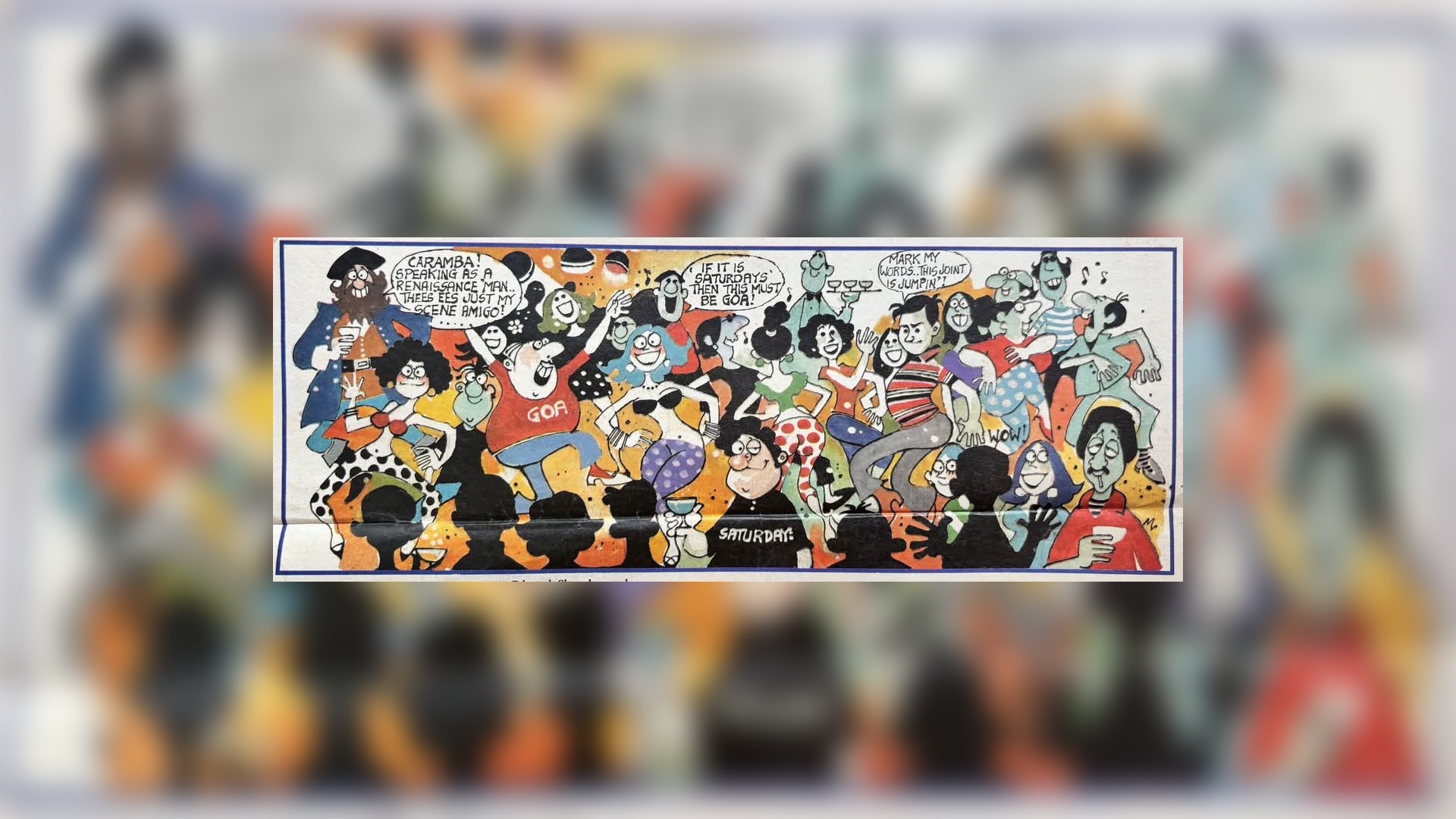
And then there is this artwork of his that I treasure most. In 1995, at the opening of a casino at a beachside hotel in Goa, I had insisted the hosts invite Mario along. After all, he was, in a sense, the patron saint of the state. I wrote about the spectacle; he illustrated it. In one of those colour sketches, he mischievously captured me dancing, my name emerging from a speech bubble in his unmistakable hand. To be drawn by Mario was to be gently observed, affectionately exaggerated, and admitted into his world. It was both compliment and mischief — and entirely him.
About Mark Manuel

The above thoughts/content has been proudly copied from the wall of Sir Mark Manuel. Being interviewing almost every role model of this country and going stronger each day. Mark Manuel is a respected Mumbai editor, writer, and columnist.
With over three decades of journalism in leading publications. This includes the Free Press Journal, Times, Dainik Bhaskar, Mid-Day, and Afternoon. He is famous for his brilliant pen interviews. He himself is a TEDx speaker.
Further
His interviews have featured in several leading media houses. They include the Hindustan Times, Huffington Post, BBC, and Network 18. Almost every famous person has been interviewed by him in the country from Mother Teresa to Muhammad Ali. His first book is just out. It’s titled Moryaa Re! It is a crime thriller that is perhaps the country’s first police procedural. He began his career covering crime. And in a tribute to his experience and knowledge of this beat.
Several distinguished officers of the Mumbai Police and its Crime Branch collaborated with him to make this book possible. Amitabh Bachchan wrote the forward in a statement of friendship for Mark Manuel and admiration for his work.
About Story of Souls
Leave your comments on how you like this story. If you love it, share it to bring that change we wish to see in the world.
You can also share your inspiring story with us at submitstories.storyofsouls@gmail.com. Story of Souls is an initiative where we invite people to bring their stories to us. We want people to “write to heal.” The idea of Storyofsouls is appreciated by ALL INDIA RADIO. An Online Platform where you can share your real-life stories. The impact of our stories has reached the UN and Harvard University. For some real-life stories, web series are also planned. You can also visit our YouTube channel. You can follow us on Facebook LinkedIn Instagram.
Storyofsouls is glad to inform you that we are now a Google News-verified platform.
We are proud to inform you all that storyofsouls.com is the official TEDx MotiJheel Kanpur Partner for their upcoming event.