

Ananya got the role.
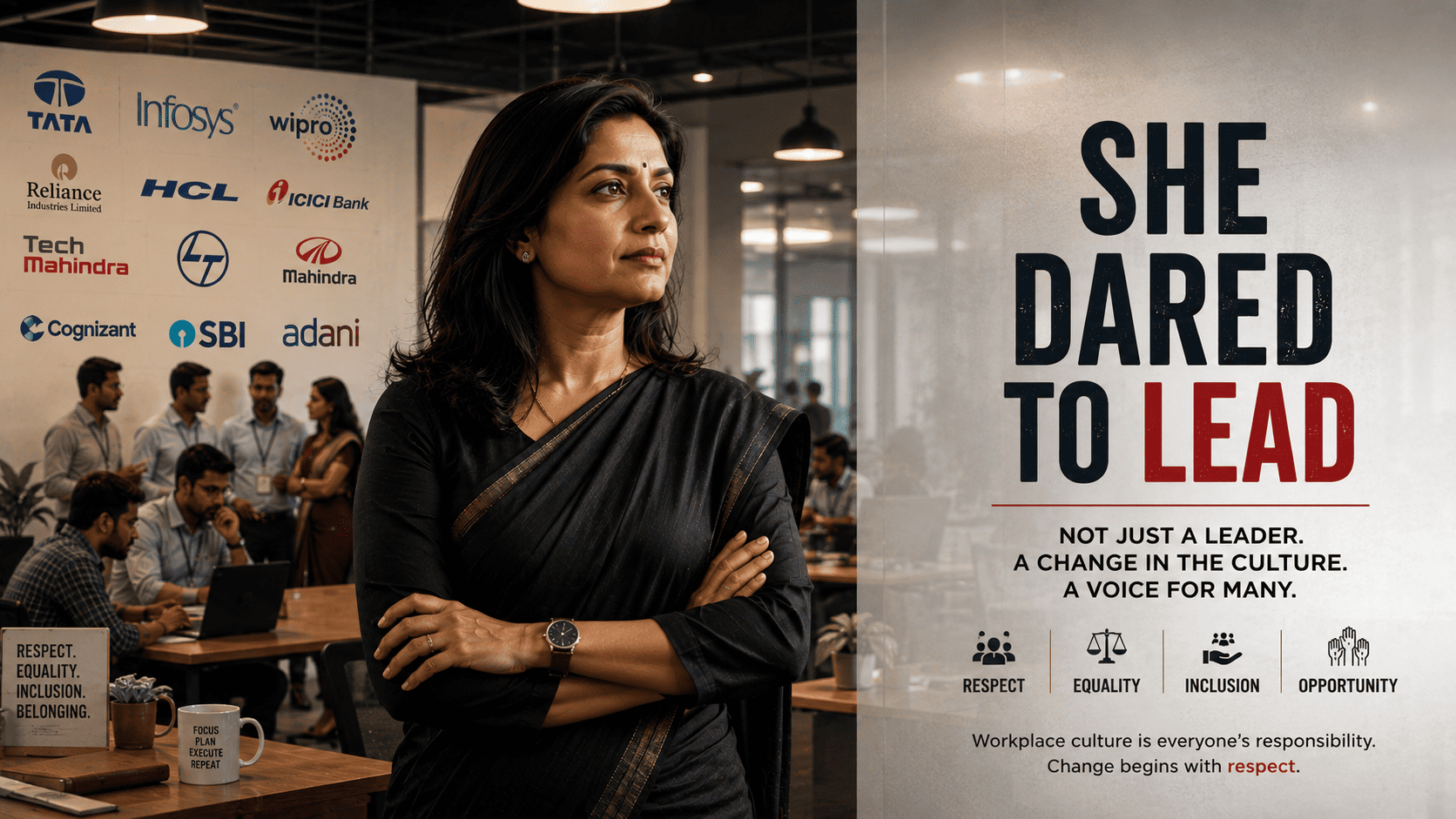
Let this be said clearly, at the beginning, so that it does not get lost: she got it. She applied, she was evaluated, she was selected. She became the first woman to lead a division of over three hundred people in her organisation’s twenty-two year history. She was forty-seven. She had earned it, by any metric you cared to use, more than a decade before it was given to her.
What happened next is what this story is about.

She became the first woman to lead a division in her organisation’s twenty-two year history. What happened next is what this story is about.
The first six months
The whisper network moves faster than any org announcement. Before her first all-hands, the narrative had already been built — by people who had not worked with her, about a woman they had mostly seen across conference rooms.
She was too direct. (Her male predecessor had been celebrated for his decisive communication style.)
She was too demanding. (Her male predecessor had been called results-oriented.)
She didn’t smile enough in meetings. (Her male predecessor had never been assessed by his facial expressions.)
She went home at six-thirty instead of eight. (Her male predecessor had done the same; no one had documented his hours.)
She was, in the word that followed her everywhere that first year: difficult.
Difficult. The most load-bearing word in the lexicon of female leadership. It means: she does not make it easy for us to dismiss her, and we find this exhausting.
Difficult. The most load-bearing word in the lexicon of female leadership.
What leading while female actually costs
Ananya has read the research. She knows what she is experiencing has a name and a literature and a pattern replicated across industries and geographies. Knowing this helps, in the way that a diagnosis helps — it does not remove the illness, but it removes the isolation.
What the research does not fully prepare you for is the accumulation.
Each individual incident is small. A colleague who speaks over her in a meeting — once, fine, humans are imperfect. A junior team member who emails her male deputy to confirm a decision she has already made — once, perhaps he had a prior relationship. A board member who addresses the room and then, turning to her specifically, asks if she would mind taking notes — once, she gave him the benefit of the doubt. She gave everyone the benefit of every doubt, for a long time.
But the accumulation is not small. The accumulation is a different thing entirely. It is the texture of a working day in which you must be, at all times, more precise, more prepared, more careful, more controlled than your male counterparts — because the margin for error assigned to you is narrower, and the interpretation of any error is harsher.
She leads three hundred people. She is also, every day, managing the perception of those three hundred people about what a woman who leads looks like. She is carrying the role and the representation of the role simultaneously. This is work that her male predecessor did not have to do. It is invisible on any job description. It is exhausting in ways that are genuinely hard to explain to anyone who has not carried it.
What she told her daughter
Ananya has a daughter. Nineteen, in her second year of college, interested in business. They talk often.
“She asked me once whether I thought it was worth it,” Ananya says. “Whether I would do it again, knowing what I know.”
She was quiet for a moment.
“I told her: yes. Not because it has been easy. It has not been easy. But because the alternative — stepping back, making myself smaller, waiting to be invited into rooms I have earned the right to walk into — that was a different kind of hard. And it was a hard that I carried alone, in silence. At least this hard is visible. At least when I walk into a room now, the room cannot pretend I am not there.”
She pauses.
“And I told her: you will have to decide which kind of hard you can live with. I cannot decide that for you. But I will tell you this — the rooms need you in them. Not because you are a woman. Because you are capable. And those two things should not be in tension. The fact that they are — that is not your failure. That is theirs.”
A question to sit with
If a woman in your organisation leads exactly as a man does — same decisions, same tone, same hours — does she get the same room’s respect? If not: why not?
This story is part of the ‘Invisible at 40’ series on storyofsouls.com — a space for real voices, told with dignity. If this story is yours, or close to it, we invite you to share it. Write to us.
storyofsouls.com | Write to Heal