

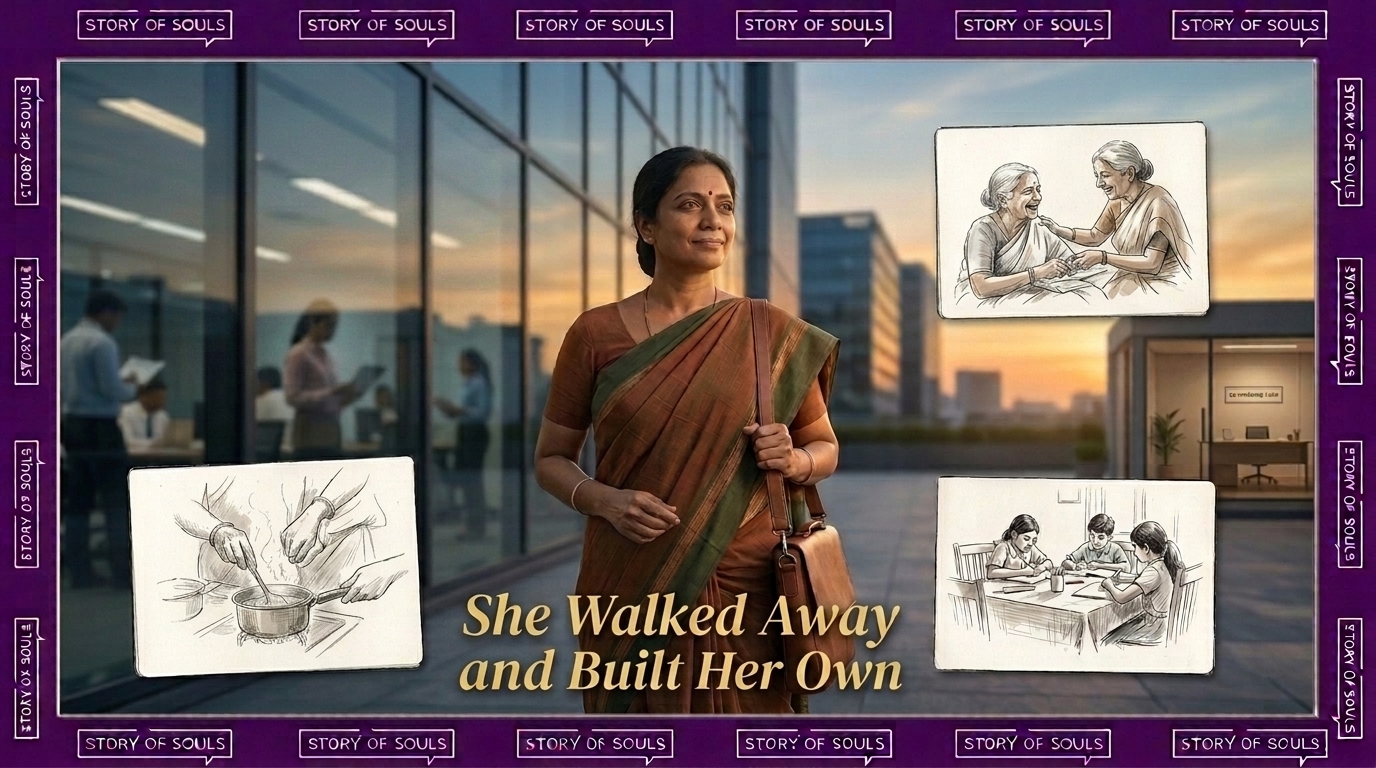
Kavitha left on a Tuesday.

Not dramatically. There was no final speech, no door slammed, no moment of cinematic reckoning. She handed in her resignation letter to an HR manager she had never liked, collected the small cactus from her desk — she had kept it alive for eleven years, which felt symbolic — and walked to the lift.
She was forty-five years old. She had twenty-two years of experience in brand strategy. She had a savings account with enough in it for eight months if she was careful. She had no plan.
She had, finally, the clarity she had been trying to find for years inside a system that had no interest in giving it to her.
She had, finally, the clarity she had been trying to find for years inside a system that had no interest in giving it to her.
What came before the Tuesday
Kavitha’s story contains all the others.
She had been the woman in the room whose ideas were taken. She had been the woman whose years of building something — a team, a department, a body of work — were measured against what she had earned rather than what she had created. She had been managed by men who confused control with leadership, who needed her capable enough to be useful but not so capable as to be threatening.
She had stayed because leaving is scary. Because the salary was real and the mortgage was real and the school fees were real. Because she kept believing, in cycles of hope that grew shorter each time, that the next appraisal cycle would be different, the next manager would see her differently, the next opportunity would finally land where she had earned it.
At forty-four, she was passed over for a role she had built from nothing. The role was given to a thirty-one year old man who had been in the company for eighteen months. In his announcement email, her contributions to the function were listed — without her name.
She read the email twice. She closed her laptop. She sat very still for a long time.
Then she opened a new document and wrote, for herself only, a list of everything she knew how to do.
It was a long list.
She opened a new document and wrote, for herself only, a list of everything she knew how to do. It was a long list.
The first year
People ask her if she was scared. She laughs.
“Of course I was scared. I was terrified. I had spent twenty-two years inside a structure, and structures, even when they are bad for you, become a kind of skeleton. When you remove them you have to find out whether you have bones of your own.”
She did.
The first three months were quiet and frightening and occasionally euphoric in ways she had not anticipated. She slept well for the first time in years. She noticed this. She had not realised how much of her nervous system had been quietly occupied by the management of other people’s egos and politics and fragile authority.
She took one client in month two — a small startup, founders in their late twenties, who needed brand strategy and had no money for a big agency. She charged them fairly. She did the work in half the time it would have taken a team of eight inside her old company. She delivered something that worked.
They referred her to someone. That someone referred her to someone else.
By month eight she had four clients. By the end of year one, six. She hired a part-time coordinator. She rented a small workspace — not a big office, a shared space, a desk with her name on a small card, which she photographed and sent to her mother.
What she has now
Kavitha is forty-seven now. Her consultancy has a small team of three — herself and two women, both in their forties, both with the kind of experience that larger organisations had found inconvenient.
She does not have the salary she had at her old company. She has more than she expected. She has equity in the thing she is building. She has the ability to decide what work she does and who she does it with and at what pace. She has, for the first time in twenty years, the sense that what she builds accrues to her.
“The hardest part was not the money,” she says. “The hardest part was the identity. I had been somebody’s employee for so long that I had confused the role with the self. When I left, I had to find out who I was when I was not being evaluated by someone else’s criteria.”
She is quieter now than she was in her corporate years. More deliberate. She does not speak in every meeting because she no longer needs to prove she belongs in the room. She owns the room.
She had confused the role with the self. When she left, she had to find out who she was when she was not being evaluated by someone else’s criteria.
What she says to the women still inside
She is careful here. She does not romanticise her choice. Leaving requires resources, risk tolerance, and timing that not every woman has — and she knows this.
“I am not saying everyone should leave. I am saying everyone should know that leaving is possible. That there is life outside the system that diminished you. That your expertise does not belong to the organisation that refused to value it. It belongs to you. It came with you. It will leave with you. And it will still be worth something the day after you walk out.”
She pauses. Outside her window — the small workspace, the desk with her name — a late afternoon in the city is arranging itself into the particular gold that comes before evening.
“I wasted years being grateful for crumbs from a table I had helped to build,” she says. “I do not say that with anger. I say it so that someone younger reads this and starts counting their crumbs a little earlier than I did.”
“You built the table. Remember that.”
A note to close the series
These six stories are composites of real women, real moments, real truths. The names are fictional. The experiences are not. If you recognise yourself in any of them — in all of them — you are not alone. Story of Souls was built for exactly this: to say the thing that needed saying, in the voice it deserved to be said in. With dignity. Without apology.
This story is part of the ‘Invisible at 40’ series on storyofsouls.com — a space for real voices, told with dignity. If this story is yours, or close to it, we invite you to share it. Write to us.
storyofsouls.com | Write to Heal