


Meera was forty-three when she stopped raising her hand in meetings.

Not because she had run out of things to say. Not because the ideas had dried up. But because she had learned — slowly, the way you learn things that cost you — that raising her hand was merely the beginning of a longer, quieter humiliation.
She would speak. The room would continue. Two minutes later, a male colleague — sometimes younger, sometimes not, always louder — would say the same thing. And the room would nod. The room would write it down. The room would attribute it to him.
She had learned that raising her hand was merely the beginning of a longer, quieter humiliation.
This is not a story about one bad manager or one broken company. This is a story about a pattern so ordinary it has become wallpaper. You stop seeing it. You walk past it every day. Until one day, you realise the wallpaper has been quietly pressing you smaller.
The years before forty
Meera had joined her company at twenty-six. Bright, meticulous, fast. She could see three problems ahead of where everyone else was standing. Her manager in those early years — a woman, incidentally — had said: “Meera has a quality I rarely see. She thinks from the customer backwards, not from the organisation forwards.”
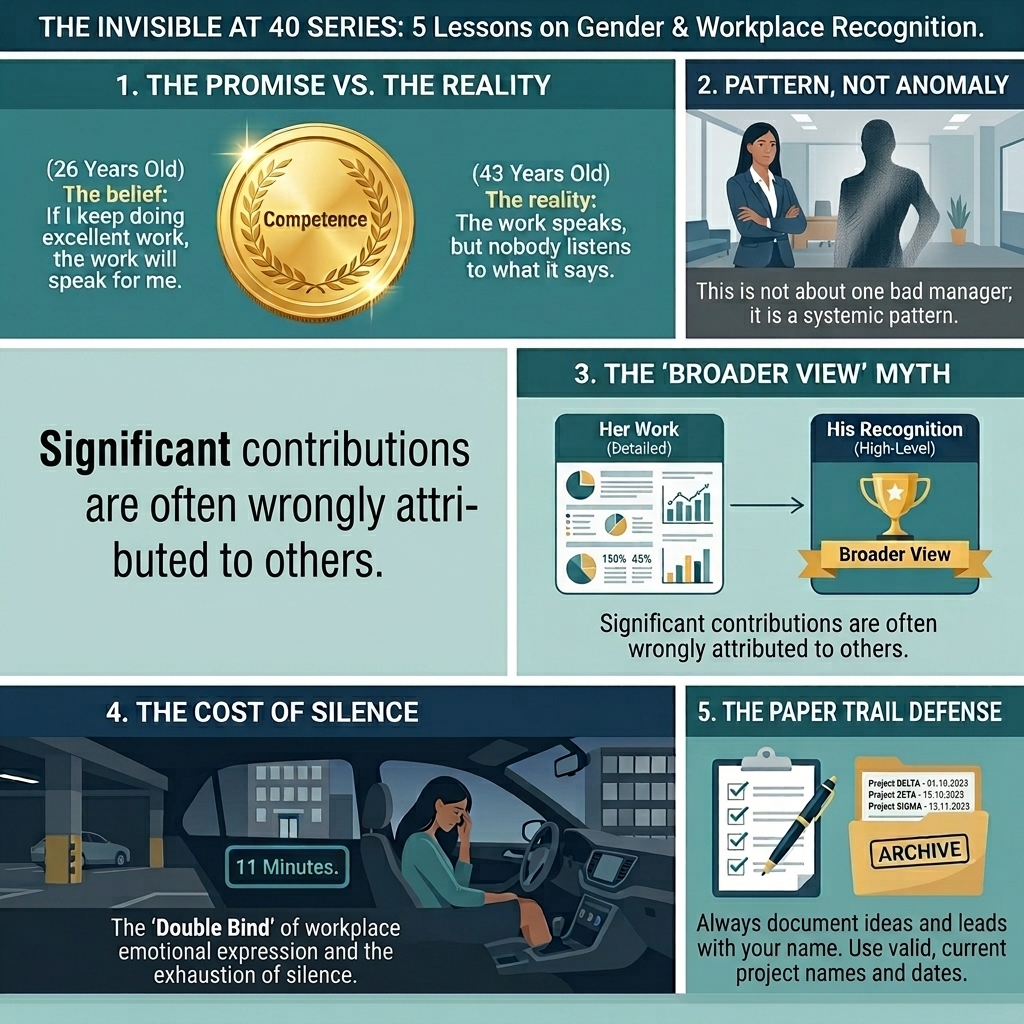
She had believed, in those years, that this quality would carry her. That competence was a kind of currency. That if she kept doing excellent work, the work would speak for her.
It spoke. Nobody listened to what it said.
The year everything shifted
She was thirty-nine when she put together the proposal that changed her company’s entire regional strategy. Forty slides. Six months of research. Three rounds of data validation. She had worked on it through her daughter’s school play, through her mother’s hospital stay, through a monsoon that had flooded her society and meant she was on calls at midnight with her laptop balanced on a stack of encyclopaedias to keep it dry.
The proposal was approved. It was a significant moment — the kind that earns a title change, a public acknowledgement, a step up.
She got a congratulatory email. Her male colleague — who had sat in two of her working sessions, contributed one slide, and asked three clarifying questions — got the promotion.
When she asked why, her manager said: “Rohit has a broader view of the business. He’s ready for the next level.”
She had written the strategy. He had the broader view.
She had written the strategy. He had the broader view.
She did not cry in the office. She had learned not to do that — because a woman who cries is emotional, and an emotional woman cannot lead. She went to the car park. She sat in her car for eleven minutes. Then she went back upstairs and answered her emails.
What forty looks like from the inside
By forty-three, Meera had seventeen years of experience, two decades of institutional knowledge, and a reputation — among those who actually worked with her — as someone you called when a problem was too complex for everyone else.
She was not invisible in ability. She was invisible in record.
No title to show for what she had built. No award on the shelf. No moment in a town hall where someone said her name and the room understood what it meant. The organisation had taken her work, metabolised it, and attributed it, quietly and systematically, to the structure around her — to the team, to the initiative, to leadership. Never to her, by name, in writing, in any room that mattered.
She had become one of those people who hold everything together while everyone else takes bows.
There is a word for this in Hindi — the person who does the काम but never gets the नाम. The work, but never the name.
She was not invisible in ability. She was invisible in record.
The cruelest part was not the individual moments of erasure. The cruelest part was the way it had been normalised. Her male colleagues were not monsters. They were ordinary men who had absorbed a system that made their visibility the default and hers the exception. They did not think about it. Why would they? The water does not think about the swimmer it holds up.
What she wants you to know
Meera still works. She still shows up. She has not given up — and this, she will tell you firmly, is not the same as being fine.
“I am not asking for special treatment,” she says. “I am asking to be seen for what I have actually done. Not what someone assumes I am capable of based on my age and gender. What I have done. The work that exists. The results that are on record. Look at them.”
She has started documenting everything now. Every idea she contributes in a meeting — she follows up with an email. Every initiative she leads — she puts her name in the subject line. She has built a paper trail, because she learned, at forty, that a woman’s credibility is not inherited. It must be constructed, archived, and defended.
She finds this exhausting. She finds it necessary.
“The saddest part,” she says, “is that the young women joining now — I see them doing what I did at twenty-six. Believing that the work will speak. I want to tell them: the work will speak. But you must make sure there is a record of who said it first.”
A question to sit with
When did you last hear a woman’s name said — clearly, in full, in a room with power — for work that was entirely hers?
This story is part of the ‘Invisible at 40’ series on storyofsouls.com — a space for real voices, told with dignity. If this story is yours, or close to it, we invite you to share it. Write to us.
storyofsouls.com | Write to Heal