

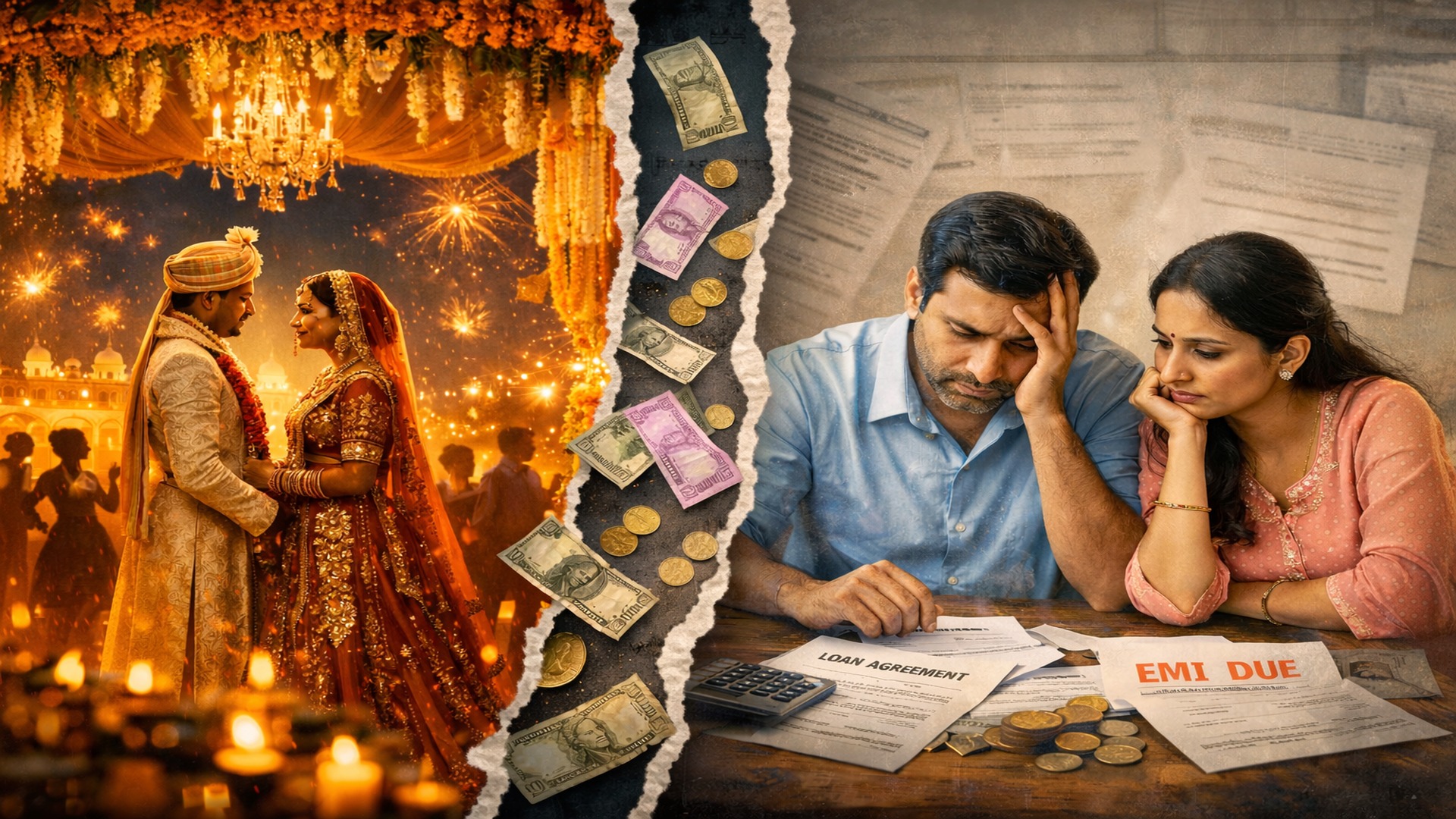

There is a moment at every Indian wedding, somewhere between the baraat and the pheras when the spectacle becomes so overwhelming that the cost becomes invisible. Relatives weep with joy. The bride is radiant in her gold. The catering is spectacular. The fairy lights turn the farmhouse into something out of a dream. And nobody in that moment is counting the EMIs.
The Big Fat Indian Wedding is one of the most celebrated, most aspirational, and one of the most financially destructive cultural institutions in modern India. And yet, year after year, family after family continues to chase it with a fervour that borders on the sacred.
The Emotional Architecture of the Indian Wedding
To understand why Indians spend the way they do on weddings, you must first understand what an Indian wedding is actually about. It is not merely a ceremony. It is a once-in-a-lifetime performance of identity, status, love, and belonging.
For the bride and groom, it represents the pinnacle of being cherished. The wardrobe, the gold, the perfumes, the jewellery, are the material proof of being loved. There is something profoundly human in wanting to feel like royalty for one week of your life, to be pampered, adorned, and celebrated in a
way that ordinary existence simply does not permit.
In a society where social capital is built over generations and lost in a single act of perceived inadequacy, the wedding becomes a high-stakes performance with an audience of hundreds.
Key Statistics:
• Average metro upper-middle class wedding spend: ₹5 Crore+
• India’s wedding industry estimated at 6–7% of annual GDP
• 10 million+ weddings held in India every year
• Average spend duration: 1 week for a lifetime of savings
The Trousseau of Dreams: When Shopping Becomes Sublime
The shopping that precedes a wedding is unlike any retail experience in human existence. The silks pulled out from behind counters in Varanasi or Kanjivaram. The jadau sets laid out in Zaveri Bazaar. The bridal lehengas tried on in airconditioned showrooms. For many Indian women who have spent their lives in frugal, disciplined households this is one moment when restraint is lifted entirely.
In many Indian families, the wedding is also the occasion for establishing a new household from scratch, furniture chosen together, curtains picked out, a kitchen stocked, a bed frame that will last a lifetime.
The Destination Wedding: The Summit of Aspiration
At the apex of Indian wedding culture sits the destination wedding, Udaipur’s lake palaces, the beaches of Goa, the villas of Tuscany, the fortresses of Rajasthan. For those who can truly afford it, destination weddings are extraordinary. They gather the closest people in a beautiful place and create memories that linger for decades.
But destination weddings have also become aspirational targets for families operating far below the income level required to fund them sustainably. The Instagram images are democratic; the price tags are not. And in the gap between what is seen and what is financially real, enormous damage is done.
The Other Side of the Mandap: When Love Becomes Debt
Here is where the conversation must turn uncomfortable. A middle-class Indian family with a combined annual income of ₹15–20 lakhs may spend ₹50–80 lakhs on a wedding. That is three to five years of their entire gross income. Spent in a week. On food consumed, flowers wilted, and music that ended at midnight.
The savings that built that sum were accumulated over decades of school fees skipped, vacations declined, medical expenses deferred. And the spending that depleted it happened in 72 hours of celebration, for an audience of people who will, within the year, be preoccupied entirely with their own lives.
The honest question nobody asks at the wedding: of the 600 people at this celebration, how many will be present when the couple faces a medical crisis, a job loss, or a moment of genuine need? The answer, for most families, is a handful. You spent for an audience. The audience went home.
The Social Compulsion: Why Families Cannot Easily Say No
To understand why intelligent, financially literate families still overspend on weddings, you must understand the social trap they are in. In Indian social networks, weddings are comparative events. The catering will be compared. The décor will be remembered. The number of courses, the quality of the band, the grandeur of the venue, all of it feeds into a social evaluation that will follow the family for years.
To ‘cut corners’ on a wedding is not experienced as a financially prudent decision. It is experienced as a confession: we could not manage it. This is not irrationality, it is a rational response to social incentives that punish restraint. The tragedy is that the system is self-reinforcing: everyone spends more than they can afford because everyone else is doing the same.
The Reckoning That Follows
Post-wedding financial stress is one of the most common problems financial counsellors see among Indian families. Loans taken for the wedding collide with the ordinary expenses of establishing a new household. The couple begins their marriage under the weight of debt incurred before a single day of their shared life began.
A wedding is supposed to be a beginning, but when it begins with a depleted bank balance and an absent emergency fund, the foundation is not solid gold.
The Ego at the Centre of It All
Some of the overspending is about the simple, human desire to be seen as someone who is the best. But the satisfaction of throwing the grandest wedding peaks on the last night of the celebration and then begins its slow, inevitable decline.
The question worth sitting with honestly: whose approval are you seeking, and what is it worth to you in concrete terms? If the answer is that you are spending ₹50 lakhs to be admired by people who will not remember the details within two years, that is a choice, but it should be made consciously, not by default.
What Could the Money Have Built Instead?
Consider the arithmetic. ₹30 lakhs, the lower end of a mid-tier Indian wedding budget invested in a diversified portfolio at the beginning of a marriage, compounds over 25 years into approximately ₹3–4 crores. That is a retirement corpus. That is the education fund for two children. That is the medical safety net that makes the difference between catastrophe and manageable difficulty.
It is also a down payment on a home without a concurrent wedding loan. It is seed capital for a business. It is the freedom to take a career risk because the financial cushion exists. The question is not whether to celebrate, the question is what you are willing to mortgage for the scale of that celebration.
A Different Vision: Celebration with Clarity
The alternative to the Big Fat Indian Wedding is not a courthouse ceremony with twelve people but rather an intentional celebration, knowing why you are spending each rupee, and on what, and for whom.
There are Indian families who have begun to find this path: who host weddings that are beautiful, meaningful, and genuinely within their means. Who invest in the marriage rather than the wedding. Who prioritize the first home over the first night’s five-star banquet. Who measure the success of the celebration not by what the guests said leaving the venue, but by what the couple’s finances look like one year later.
The Big Fat Indian Wedding will not disappear. It is too deeply woven into who we are as a people, our love of colour, our instinct for community, our conviction that important moments deserve to be marked with beauty.
But the most loving thing a family can do for the couple is to ask what that couple will actually need in the decades of the marriage.
In other words, while you give them a beautiful day, also give them a secure future.
FAQs
1. Why are Indian weddings so expensive?
Indian weddings are expensive because they are rarely treated as simple ceremonies. In many families, a wedding is a large social event involving multiple functions, extensive guest lists, jewellery, clothing, décor, catering, gifts, photography, and sometimes destination travel. Social expectations and comparison with peers often push families to spend far beyond their comfort zone.
2. How much does a middle-class Indian wedding typically cost?
A middle-class Indian wedding can cost anywhere between ₹15 lakh and ₹80 lakh, depending on the city, guest count, venue, jewellery, and number of events. In many cases, families spend several years’ worth of income on a single wedding, especially when trying to meet social expectations or host a destination celebration.
3. Why do families overspend on weddings in India?
Families often overspend because weddings in India are tied to status, social approval, family pride, and emotional symbolism. Even financially aware households may feel pressured to match or exceed what relatives and peers have done. For many, cutting costs is seen not as prudence, but as a public signal that they “couldn’t afford it.”
4. Are destination weddings worth the cost?
Destination weddings can be worth it only if they are genuinely affordable for the family and couple. For those with sufficient wealth, they can create intimate and memorable experiences. However, for many middle-class families, destination weddings become financially damaging because the aspirational appeal is high while the real costs travel are often underestimated.
5. What are the hidden financial risks of a lavish wedding?
The hidden risks include:
- Depleting long-term family savings
- Taking personal loans or using high-interest credit
- Starting married life with debt
- Delaying a home purchase
- Weakening emergency funds
- Reducing retirement security
- Creating financial stress in the first years of marriage
A lavish wedding may last a few days, but its financial consequences can last for years.
About Story of Souls
Leave your comments on how you like this story. If you love it, share it to bring that change we wish to see in the world.
You can also share your inspiring story with us at submitstories.storyofsouls@gmail.com. Story of Souls is an initiative where we invite people to bring their stories to us. We want people to “write to heal.” The idea of Storyofsouls is appreciated by ALL INDIA RADIO. An Online Platform where you can share your real-life stories. The impact of our stories has reached the UN and Harvard University. For some real-life stories, web series are also planned. You can also visit our YouTube channel. You can follow us on Facebook LinkedIn Instagram.
Storyofsouls is glad to inform you that we are now a Google News-verified platform.
We are proud to inform you all that storyofsouls.com is the official TEDx MotiJheel Kanpur Partner for their upcoming event.