

She wakes before the world remembers it is alive. No alarm. No notification. Just the body’s own wisdom, the same clock that has run since the days when water did not come to the tap but had to be coaxed from the earth, carried across kilometers on a head that knew the weight of survival. She walks now not because an app has set a step goal, but because her legs have always been her most faithful companions. The road is quiet.
The air is cool. And she is, by every measure that matters, among the healthiest people alive.

There is no wearable on her wrist tracking her heart rate. Her heart does not need tracking. It is being charged by the cold morning, by the rhythm of footfall on familiar ground, by the faint sound of a neighbour’s door opening, by the small nod of recognition that says: I see you, you are real, you are here.
The distance that gave her everything
She will tell you, without a flicker of regret, that in her time the water source was a long walk away. Not a two-minute shuffle to a kitchen sink. A real walk — lungs working, shoulders bearing, legs learning the language of endurance. The women would go together, mornings when the light came in slanted and soft, and the conversation that happened along that path was something no message thread has ever replicated.
It was not a WhatsApp community. There were no admins, no muted notifications, no passive-aggressive reactions to someone’s forwarded news. It was just voices, carried by breath, met by ears that were genuinely present. Laughter with a whole body behind it.
Grief shared without anyone asking if it was too much. Problems whispered and carried collectively, without screenshots, without judgment, without the half-presence of someone who is typing elsewhere while you speak.
They were not performing community. They were simply being one.
The pot that was always shared
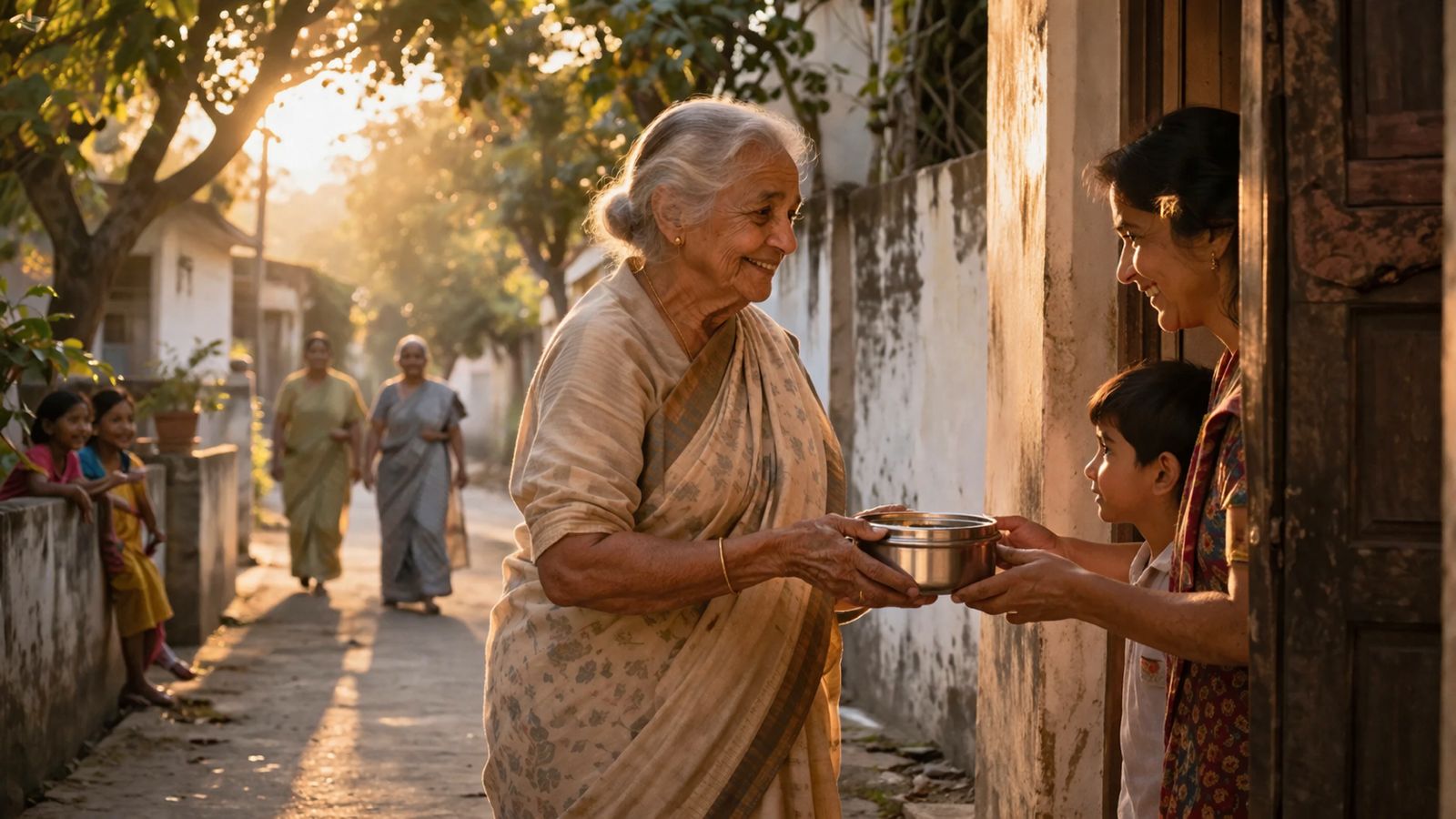
There was a custom that when something delicious was made in your kitchen, a portion found its way next door before it even reached the table. Not delivered by an app. Not accompanied by a photograph for the feed. Just carried, warm, in a steel dabba, by a pair of hands that had been cooking since before sunrise and wanted someone else to taste what they had made.
A new pickle was being tried for the first time? The neighbour got some. The halwa made on a Tuesday for no reason in particular? A bowl went across the wall. The biryani that came out especially well this Sunday? The family downstairs would know about it within the hour, not through a status update, but through smell and footsteps and a knock on the door that meant come, eat, there is too much and it is too good to eat alone.
This was not charity. It was not performance. It was something more quietly profound: the understanding that pleasure is incomplete when it is unshared. That the best food is the food that travels. That a recipe is not truly yours until you have given it away, and watched someone else’s face change when they tasted it.
Sunday lunches that nobody needed to plan
And then there were Sundays. Not the Sundays of brunch reservations and curated menus and the mild anxiety of whether the restaurant will have a table. The Sundays where you simply walked to the neighbour’s house, past the neem tree, past the children playing in the lane, because that is what Sunday meant. Because the doors were open. Because there was always enough.
It was not scheduled. There was no calendar invite, no RSVP, no group deciding three days in advance whether Sunday would work for everyone’s busy lives. You went. They fed you. The next Sunday, or some Sunday, they came to you. The food was simple. The conversation went everywhere. The children ate on the floor. The elders sat in the best chairs and were served first. And nobody counted the hours.
These lunches were not just meals. They were the maintenance of something invisible and essential, the feeling of belonging, of being woven into a fabric of other lives, of knowing that your presence was expected and your absence would be noticed. That is not a small thing. That is, in fact, the whole thing.
The neighbourhood that remembered your name
When the vehicle broke down, the neighbour came. Not an Uber link. A person, with hands and time. When the fridge stopped working in the heat of summer, someone arrived with a steel dabba of cold water and the casual grace of someone who had decided that this was simply what you did. You showed up.
This is what we have forgotten. Not the fact of community, we still use the word, still claim it in our bios, but the texture of it. The safety it carried. The extraordinary ordinariness of being known by the people around you. Of having a web of human presence that would catch you before the fall became a crisis.
Psychologists have a term for what emerges when this web is intact: a felt sense of safety. And felt safety, it turns out, is not a soft idea. It is physiological. When the nervous system trusts its environment, it does not flood the body with cortisol. The heart does not race at 2 a.m. for no reason. The mind does not spiral. Anxiety does not colonise the hours that should belong to rest.
The morning newspaper and the mercy of not knowing everything
She read the newspaper, once, in the morning. Then she folded it. Then she lived the rest of the day. She was informed, not consumed. The news arrived, was digested, and departed. It did not follow her to the kitchen, to the puja, to the afternoon nap, to the conversation with the vegetable seller. Her mind had room, room for thought, for silence, for the slow work of actually building something.
We scroll, and we do not stop. Not because we are more curious, but because the architecture of what we consume is designed to never resolve. Every piece of information arrives bracketed by outrage, dread, or the manufactured urgency of something that requires your immediate reaction. We are not more informed. We are more inflamed. And inflamed nervous systems, clinicians now know with certainty, are the substrate on which every chronic illness, physical and psychological, grows its
roots.
She was busy building her life. We are busy watching ours collapse in real time, vicariously, through a feed that never ends.
The same blood, the same breath
The community she lived in was not perfect. Communities never are. But it was built on something prior to ideology, on the simple, irreducible fact of shared humanity. When someone’s child was sick, the religion of the family did not determine whether the neighbour brought food. When the well ran dry, caste did not distribute the water from someone else’s pot. The common denominator was not doctrine. It was the body: the same blood running under different skin, the same lungs drawing the same air, the same eyes capable of the same weeping.
What we store in the mind, belief, prejudice, scripture, politics, can differ enormously. But it does not differ enough to justify the distances we have created. It does not differ enough to call it hatred. Certainly not enough to call it war. We have taken the infinite variety of human thought, which should be our greatest richness, and weaponised it into a reason to withdraw from each other until we are each alone in a room, each charging our devices, each algorithmically certain that the other side is monstrous.
This World Health Day, let’s put down the charger
We celebrate health today with the vocabulary of the individual: steps, sleep scores, VO2 max, hydration reminders, mental health apps, therapy waitlists. All of it is real. None of it is enough. Because the deepest determinants of health are not personal habits. They are relational. They are: do you feel known? Do you feel safe? If you disappeared for three days, would someone come looking, not because you posted, but because your silence would be felt?
The old woman does not use a fitness tracker. She does not need one. Every morning she walks and she is seen. Every afternoon she shops for her own vegetables, not because delivery is unavailable but because the vegetable seller’s face is familiar, and familiar faces are, it turns out, medicine. And somewhere in the week, she cooks something beautiful and sends it next door. Because that is how it has always been. Because she knows that the best thing you can do for your own health is to make someone else feel fed.
Her bones are not brittle. Her mind is not haunted. She is not anxious. She is, as she would say with the quiet confidence of someone who has never needed to prove it, perfectly fine.
This World Health Day, before you charge your phone, your watch, your Netflix account, consider what else might be running low. Consider the neighbour you have not spoken to in a year. The morning you gave to a screen that should have gone to the street. The pot of dal you made last week and ate alone when it could have fed two families and started a conversation that lasted all evening. The Sunday you spent scrolling when you could have walked, unannounced, to someone’s door and sat with them in the unremarkable, irreplaceable ordinariness of shared time. We were not made for thumbnails and reaction emojis. We were made for the weight of water carried together, the warmth of a shared meal, and the conversations that happened on the way.
FAQs
1. What is the core message of this story?
This story gently reminds us that true health is not just physical but it lives in connection, community, and the feeling of being seen. It invites us to look beyond modern metrics and return to what once made us feel whole.
2. Why is the story centered around an older woman’s lifestyle?
Because her life reflects a rhythm we have slowly moved away from, one rooted in movement, relationships, and presence. She represents a kind of wisdom that didn’t need validation.
3. How does community impact our health?
When we feel connected and supported, our nervous system feels safe. This reduces stress, improves mental clarity, and strengthens overall wellbeing. The story highlights how simple human interactions can act as everyday medicine.
4. What is meant by “felt sense of safety” in the story?
It is the body’s natural state when it trusts its environment. In such a state, the mind rests, the heart slows, and the body heals. This kind of safety often comes not from isolation, but from meaningful relationships.
5. Is the story suggesting we reject modern technology?
Not at all. It simply asks us to reflect that while we’ve gained convenience, what have we lost in connection? It encourages balance in using technology without letting it replace human presence.
6. Why are shared meals and neighbourhood interactions emphasized?
Because they are simple yet powerful acts that build trust, belonging, and emotional nourishment. Sharing food was never just about eating, it was about being together.
7. How is this story relevant today?
In a time where loneliness and anxiety are rising despite hyper-connectivity, this story offers a mirror. It asks us to reconsider what “health” truly means in our lives.
8. What small change can a reader take after reading this?
Start with one act: speak to a neighbour, share a meal, or take a walk without your phone. Healing doesn’t always begin with big decisions, it begins with small returns.
9. Why is this story shared on World Health Day?
Because it expands the definition of health. It reminds us that beyond fitness goals and routines, our deepest wellbeing is rooted in how we live with others.
10. What is Story of Souls trying to achieve through stories like this?
To create a space where stories heal, connect, and awaken reflection. Stories like this are not just meant to be read but to be felt, remembered, and lived. 😊
About Story of Souls
Leave your comments on how you like this story. If you love it, share it to bring that change we wish to see in the world.
You can also share your inspiring story with us at submitstories.storyofsouls@gmail.com. Story of Souls is an initiative where we invite people to bring their stories to us. We want people to “write to heal.” The idea of Storyofsouls is appreciated by ALL INDIA RADIO. An Online Platform where you can share your real-life stories. The impact of our stories has reached the UN and Harvard University. For some real-life stories, web series are also planned. You can also visit our YouTube channel. You can follow us on Facebook LinkedIn Instagram.
Storyofsouls is glad to inform you that we are now a Google News-verified platform.
We are proud to inform you all that storyofsouls.com is the official TEDx MotiJheel Kanpur Partner for their upcoming event.