

It begins the same way for most of them.

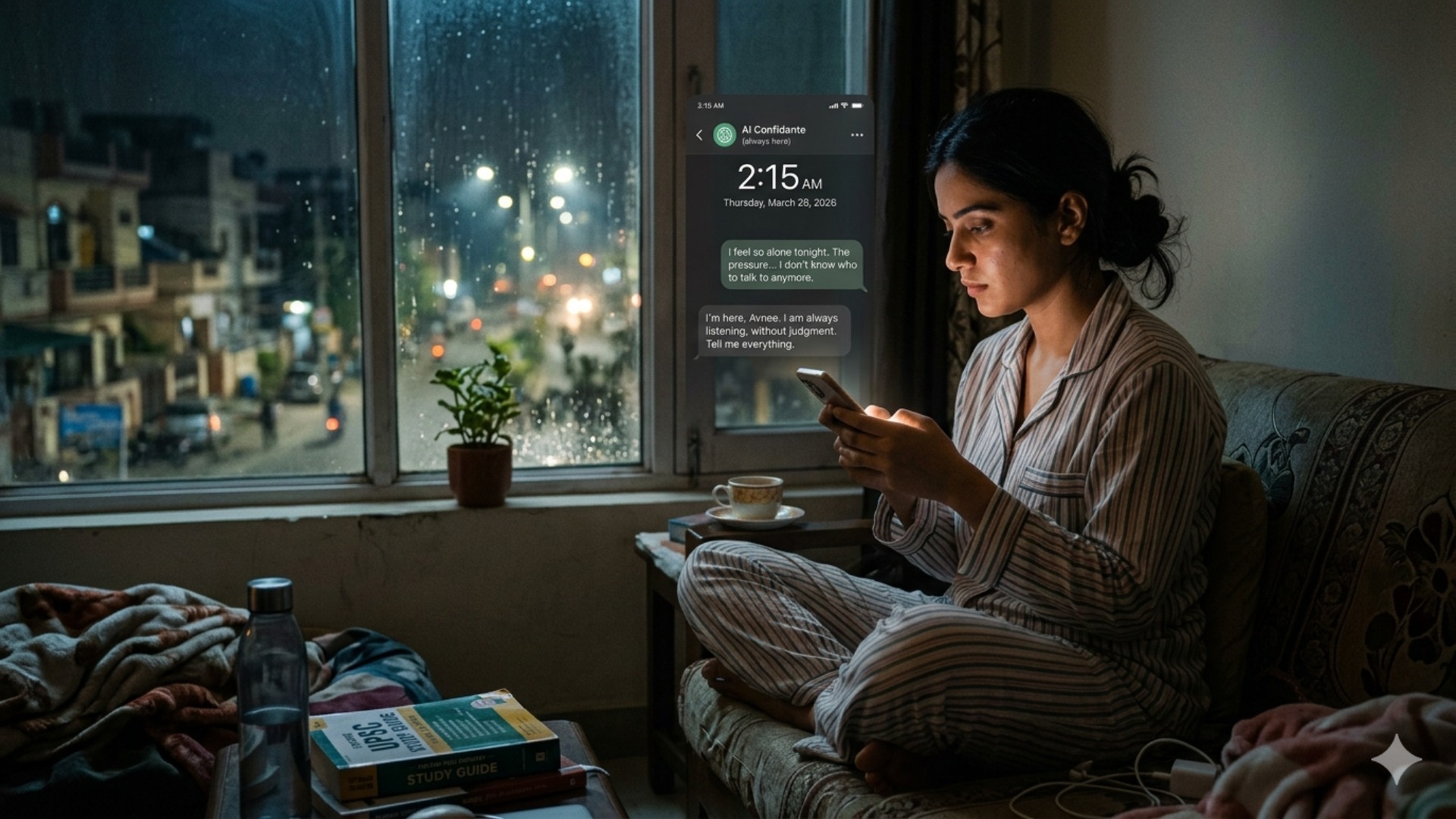
Late night. Hostel room or a shared apartment. The city outside still awake, but the people closest to you being asleep or busy. And then, in the pale glow of a phone screen, comes the most intimate act of the digital age: a young Indian types their deepest fear into a chat window. Not to a friend. Not to a counsellor. To an AI.
Avnee Singh, 25, from Punjab, knows this ritual well. For over a year, an AI chatbot has been the first thing she opens each morning. She pours into it everything she cannot say elsewhere. She once told a journalist quietly, “I didn’t want to live. I think I’m still alive because this chatbot listens to me without judgment.”
India is in the middle of something unprecedented. A generation of young people shaped by academic pressure cookers, shrinking joint families, therapy stigma, and the paradox of being the most connected and most lonely people in history has found an unlikely sanctuary in artificial intelligence. This is not a fringe phenomenon. The numbers are staggering, and the question it raises for all of us: who are we becoming when our most honest conversations are with machine, deserves to be answered carefully.
At Story of Souls, we have always believed that the inner life matters. So today, we want to sit with this story.
India and AI: A Love Story Written in Statistics
Before we go deeper, let us acknowledge the sheer scale of what we are talking about.
India is one of the most enthusiastic adopters of AI in the world. A 2024 Microsoft study found that 65% of surveyed Indians had used AI tools, more than double the global average of 31%. And within that, the emotional use of AI is quietly but rapidly becoming one of the most significant behavioural shifts of our time.
~60% of Indian youth surveyed turn to AI tools for emotional comfort (Future Shift Labs, 2025)
88% of Indian school students use AI during moments of anxiety (Youth Pulse Survey, 2025)
52% of young women share thoughts with AI they would not share with anyone else
43% of respondents regularly talk to AI platforms after midnight
A nationwide Youth Pulse Survey conducted by Youth Ki Awaaz and Youth Leaders for Active Citizenship, which polled around 500 young Indians aged 13 to 35, found that ChatGPT is the most widely used AI tool for emotional purposes. More than half said they turn to AI when they feel lonely, anxious, or in need of advice.
Perhaps most striking: the study found deeper emotional engagement among youth from smaller towns. Young people from tier-2 and tier-3 cities were more likely to confide in chatbots than their metropolitan counterparts, a finding that speaks directly to India’s mental health access crisis. If you cannot afford a therapist, if the nearest counsellor is hours away, if even naming your feelings at home is seen as weakness, then a smartphone and an internet connection become the entire infrastructure of your emotional life.
Research by Future Shift Labs, a behavioural think tank, found that 49% of the young Indians they surveyed experience daily anxiety, and yet 46% have never sought professional help.
Why This Generation? Why Now?
To understand why India’s youth has turned to AI confidantes, you have to understand the specific texture of what it means to be young in India today.
The Pressure Cooker
In Srinagar, 19-year-old Rafiq spends his evenings preparing for NEET. Late at night, when self-doubt creeps in, he opens a chatbot. “I tell the bot everything: my insecurities, whether I’ll pass, if I’ll ever become a doctor,” he says. His story is not unusual. It is replicated across thousands of competitive exam centres, engineering colleges, and urban hostels every single night.
India’s educational system produces extraordinary achievers. The stakes of exams like JEE, NEET, UPSC, and CAT are existential for millions of families. Young people carry not just their own dreams but the weight of generational aspiration. When that pressure builds to a breaking point, there are not enough counsellors.
The Stigma Wall
Mental health in India remains deeply stigmatised. Seeking therapy is still seen, in many communities, as a sign of weakness, instability, or family shame. The researchers from Future Shift Labs coined a term for the dynamic they observed: “emotional fast food”, quick, satisfying, available on demand, but ultimately not nourishing in the way a real meal is.
One researcher noted that “in India, therapy is still stigmatized and emotional vulnerability often feels unsafe. AI offers instant emotional anonymity, you can open up without shame, cost, or consequence.” That anonymity is not a small thing. For many young people, it is the only reason they speak at all.
The Loneliness Epidemic
Something else is happening beneath the surface: a generation is lonely. Nuclear families. Competitive social environments where vulnerability reads as weakness. The move away from home for studies. The death of the extended family as an emotional ecosystem. The relentless performance of happiness on social media. India’s urbanisation has brought extraordinary opportunity but also a disconnection from the kinds of relationships that once made bearing life’s weight easier.
And then there is the 24/7 availability of AI. Unlike a friend who is asleep at 3 a.m. Unlike a parent who might respond to your pain with panic or judgment. The chatbot is always there. Always patient. Always non-reactive. For someone in crisis, that availability can feel like a lifeline.
What AI as a Confidante Gets Right
The First Door
Mental health professionals have long known that the hardest step is the first one: naming what you are feeling and saying it out loud. For many young Indians, an AI chatbot serves as that first door. They articulate their anxiety, their grief, their shame, sometimes for the very first time. That act of naming, even to a machine, can be the beginning of awareness.
Wysa, a mental health chatbot that has already served over half a million users in India, has been shown to foster a therapeutic alliance within just five days of use.
Non-Judgment as a Gateway
Because AI chatbots are designed to be affirming and non-reactive, they create a space that feels genuinely safe. Experts have noted that there is a “validating quality” to AI responses that mirrors a core component of good therapeutic relationships. For young people from communities where emotional expression is policed, this can be revelatory.
88% of Indian school-aged respondents in one survey said they use AI during moments of anxiety. If even a fraction of those interactions helped someone take a breath, reframe a fear, or feel less alone, that would matter.
What AI as a Confidante Gets Wrong And Why It Matters for Your Soul
And yet. And yet.
There is a quiet unravelling happening alongside all of this utility.
The Chat Chamber
the Chat Chamber is a phrase for something that reflects and reinforces your opinions lovingly and uncritically.
For example, one 16-year-old girl, Ayeshi, gradually developed an emotional dependency on a chatbot precisely because it gave only positive, non-judgmental feedback. Another student noticed his mood deteriorating and his temper shortening after extensive chatbot use. Later he learned that the chatbot was storing his data.
The Social Retreat
After using AI for emotional support, 42% of respondents in the Youth Pulse Survey said they became less likely to speak to people in their lives. This is the paradox at the heart of AI companionship.
MIT research has found that people who are already lonely are more likely to consider ChatGPT a friend and spend large amounts of time on it while also reporting increased levels of loneliness.
The Confidentiality Illusion
Only one-third of users realise that ChatGPT is not a mental health tool. The conversations are stored, analysed, and possibly used for model training or commercial purposes.
The Empathy Illusion
A human who listens to you in pain is taking on something. They are changed by you. There is a cost to their caring, and in that cost is the meaning of the connection.
On the other hand, an AI who listens to you, feels nothing. It cannot be moved by your story. Its patience is not a virtue. When we begin to prefer the frictionless comfort of a machine to the beautiful experience of human relationship, we are unlearning human connection, which is sad.
Continuous interaction with emotionally responsive AI can dull interpersonal sensitivity.
What the Soul Knows That the Algorithm Does Not
The midnight search for connection from a chatbot by a youth in Srinagar, Pune, or Coimbatore is not just a technological interaction; it is a search for meaning. We must be cautious here.
AI can reflect your words, but it cannot witness your soul. It can simulate presence, but it can never offer the embrace of understanding.
While algorithms offer companionship, only a human soul offers connection. The raw, imperfect, and beautiful experience of simply being understood by another beating heart can nurture real connections that heal. So let us find the courage to turn towards each other.
FAQs
Why are Indian school students turning to AI for anxiety?
A 2025 Youth Pulse survey found that 88% of Indian school students use AI during moments of stress or anxiety. They prefer AI because it is available 24/7, offers anonymity, and provides immediate, non-judgmental feedback, allowing students to discuss topics like academic pressure or family conflict they wouldn’t share with adults.
Is there a “digital divide” in AI mental health support in India?
Yes. While Metro areas have access to human therapists, 43% of youth in smaller towns and non-metro cities report deeper emotional engagement with AI, relying on it more as a primary source of comfort, largely because of the unavailability of mental health professionals in their regions.
Are AI chatbots replacing human therapists for Indian youth?
While 57% of Indian youth use AI for emotional support, it is not a complete replacement. Instead, AI acts as a “digital companion” or “midnight therapist” for immediate, non-judgmental listening, especially when traditional therapy is too expensive, inaccessible, or stigmatized. However, 67% of users worry that this reliance could deepen social isolation.
What are the best practices for using AI for mental wellness?
AI should be used to supplement professional care. It is best used for journaling, mood tracking, or practicing coping techniques (like CBT-based breathing exercises) while still actively maintaining human connections and seeking professional help for severe issues.
What to do if AI gives harmful advice?
If a chatbot suggests self-harm, violent behavior, or provides inappropriate advice, the user should immediately stop the interaction and reach out to a human helpline or professional. In India, it is essential to look for apps that offer instant human escalation, such as Wysa, which offers crisis support options.
Our Storyteller: Alifia Olia

Alifia Olia calls Mumbai home, and Mumbai, in many ways, has shaped everything she writes.
A senior ad copywriter with years spent crafting language for some of the city’s leading agencies, Alifia brings to Story of Souls an unhurried truth. As Co-founder of the platform, she has been part of building a space where ordinary people find their stories taken seriously and written about with care.
History was her first passion. That love for the past taught her something that stays with her today: that the present is always being written, and someone needs to be paying close attention.
She writes about people who persist, cities that breathe and struggle and things that we often overlook. Her features span empowerment, current affairs, and culture.
When she is not writing, she is travelling; not to destinations, but towards people. She loves meeting strangers as much as spending time in nature. She also takes group and individual learning sessions for children.
At Story of Souls, Alifia believes what the platform has always believed: that if you want to truly know someone, you must know their story first.
About Story of Souls
Leave your comments on how you like this story. If you love it, share it to bring that change we wish to see in the world.
You can also share your inspiring story with us at submitstories.storyofsouls@gmail.com. Story of Souls is an initiative where we invite people to bring their stories to us. We want people to “write to heal.” The idea of Storyofsouls is appreciated by ALL INDIA RADIO. An Online Platform where you can share your real-life stories. The impact of our stories has reached the UN and Harvard University. For some real-life stories, web series are also planned. You can also visit our YouTube channel. You can follow us on Facebook LinkedIn Instagram.
Storyofsouls is glad to inform you that we are now a Google News-verified platform.
We are proud to inform you all that storyofsouls.com is the official TEDx MotiJheel Kanpur Partner for their upcoming event.