

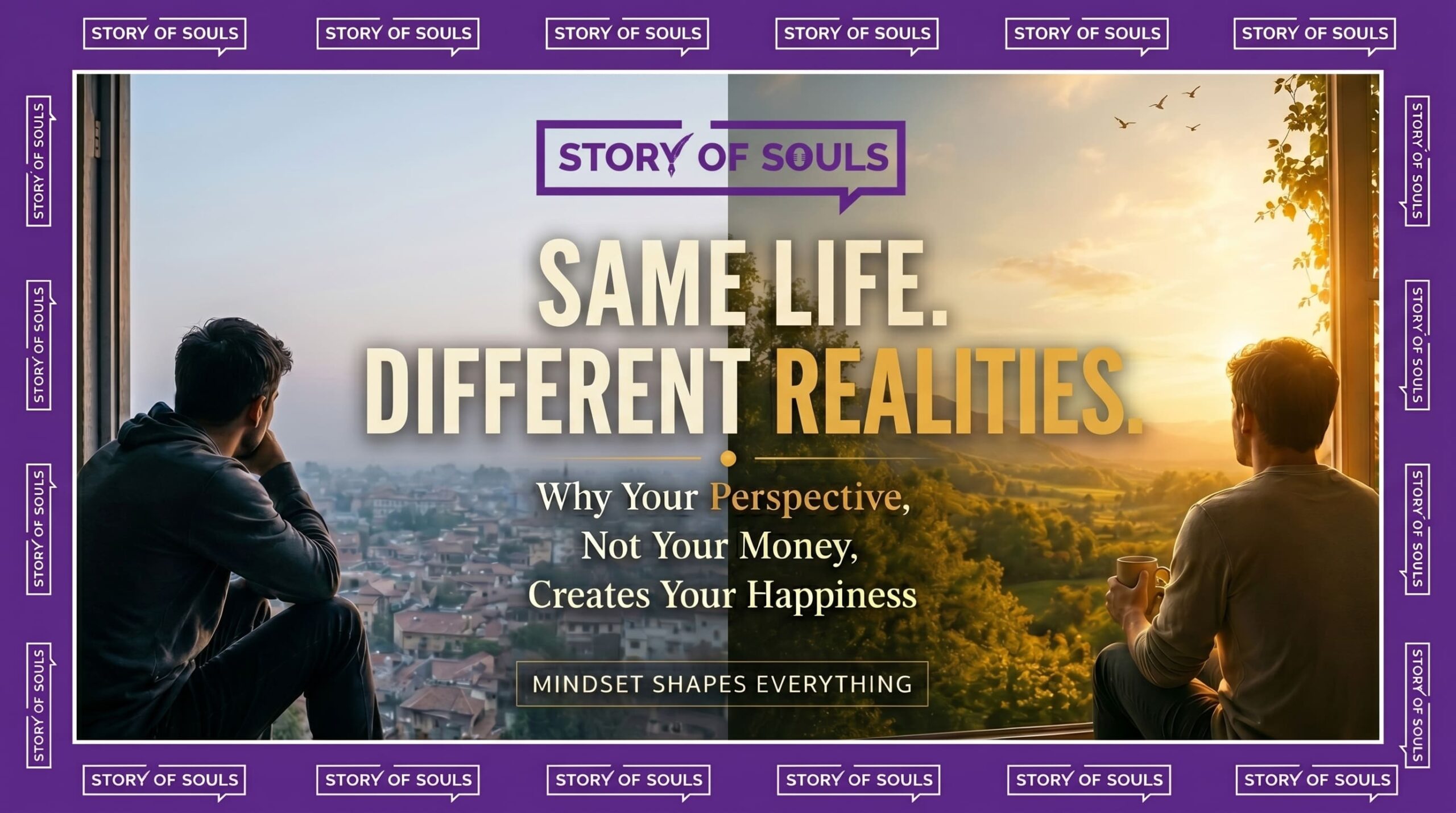
Why are rich people unhappy while the poor can be content? Can perspective alone create happiness? Explore how your mindset, not your money, shapes your life – and why unlearning old beliefs is the real path to freedom.

Two People. Same Movie. Completely Different Experiences.
Put two people in the same cinema. Same film. Same seat row. Same screen.
One walks out with tears in their eyes, carrying something heavy in their chest. The other stretches, checks their phone, and asks where to eat dinner.
Same movie. Same story. Completely different experience.
Why does this happen? Because we do not experience reality as it is. We experience it filtered through everything we have ever felt, feared, lost, or loved. The scene on screen did not create the emotion — it simply unlocked something already living inside one of them.
The first truth is this: you do not see the world as it is. You see it as you are.
Quick Answer: Why do two people react differently to the same thing?
Because every person processes what they see through their unique personal history — their past experiences, fears, beliefs, and emotions. The event is the same. The inner filter is different. This is why perspective, not circumstance, shapes how we feel.
The Glass Is Half Full — But What Does That Actually Mean?
Most of us have heard the old question: is the glass half full or half empty? We nod at it. We put it on posters. And then we miss what it is actually telling us.
The glass does not have a perspective. The water does not either.
Only the person looking at it does.
And here is what makes it fascinating: the same person can look at the same glass at 9am full of hope and see abundance — and look at it again at 11pm after a hard day and see lack. The glass has not moved. The water level has not changed.
What changed was the inner world of the observer.
The same water can look like:
- Abundance — to someone who just came out of a drought
- Disappointment — to someone who expected the glass to be full
- 50% capacity — to a scientist measuring precisely
- Loss — to someone in grief
- Recovery — to someone slowly healing
The real question is never about the glass. It is always about what you are carrying inside when you look at it.
Why Are Rich People Unhappy? The Money Paradox Explained
Here is where the conversation becomes uncomfortable.
Study after study — and centuries of human observation — keep arriving at the same finding: beyond a basic level of comfort and safety, more money does not produce more happiness. In many cases, it produces its exact opposite.
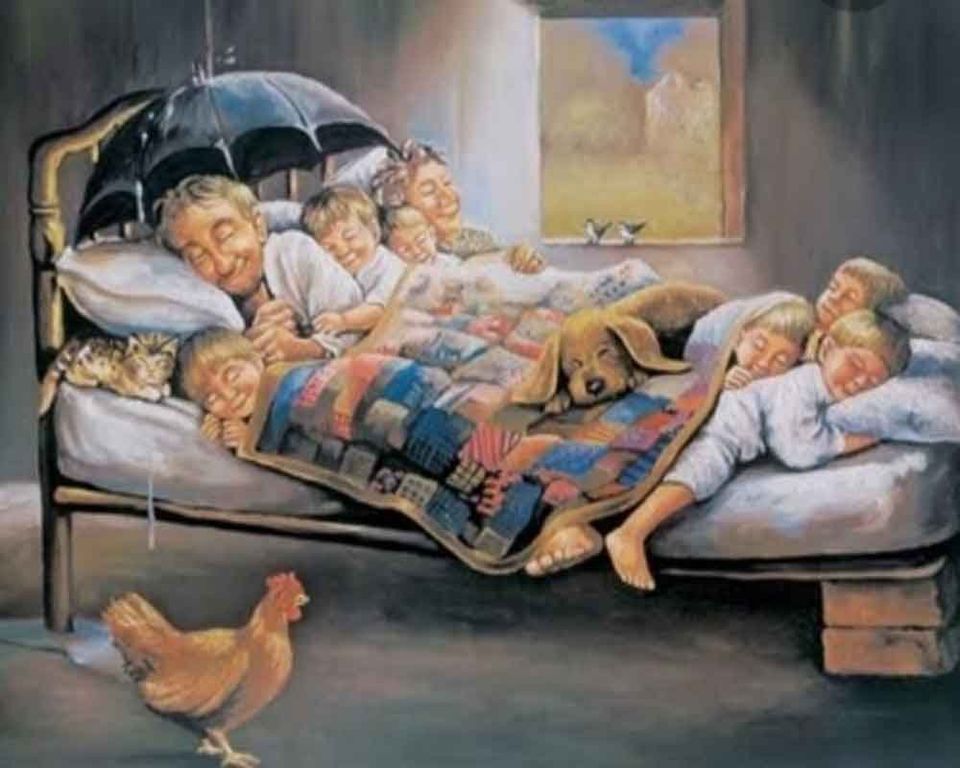
The person sleeping on a simple bed in a small village, surrounded by family, eating food cooked at home, laughing freely — is, by many real measures of inner peace, far richer than the executive sleeping poorly in a luxury apartment who has not genuinely laughed in months.
How is this possible?
Because happiness was never inside the object. It was always inside the relationship with the object.
The person with less is living inside their life — present, connected, in the moment. The wealthy person is often watching their life from the outside — managing it, protecting it, anxious about losing it. They have traded presence for possession.
Quick Answer: Does money bring happiness?
Research consistently shows that money reduces suffering caused by poverty, but beyond a comfortable baseline, it does not create happiness. Happiness is determined far more by mindset, relationships, and sense of meaning than by income or wealth.
The stress, chronic illness, and sleeplessness that follow many high-achievers are not caused by success. They are caused by the belief system carried into success — that one is never enough, that one must keep proving, that rest is weakness, that love is conditional on results.
These beliefs were there before the money came. The money just gave them a bigger stage.
Can Perspective Alone Create Happiness? What the Evidence Says
This is the question that cuts deepest: if two people in vastly different conditions can have completely reversed emotional lives, then what exactly is creating happiness and unhappiness?
Could it be almost entirely internal?
Stoic philosophers, Buddhist traditions, modern psychologists, and neuroscientists have arrived at the same answer independently: largely, yes.
Viktor Frankl survived Nazi concentration camps and wrote about finding meaning in the most extreme conditions imaginable. He did not say suffering is not real. He said the last freedom that can never be taken from a human being is the freedom to choose their response to what happens to them.
This is both the most freeing and the most challenging idea a person can sit with — because it removes every external excuse and places the architecture of your inner life entirely in your own hands.
The life you want may not require a different life. It may require a different way of seeing the one you already have.
We Are Here to Unlearn — Not Just to Learn
Perhaps the most quietly powerful idea in all of this is that we did not come here to accumulate. We came here to shed.
Every wisdom tradition that has ever reached toward truth says a version of this. Zen calls it Beginner’s Mind. Sufi teachings speak of fana — dissolving the false self. The Hindu concept of Neti Neti means ‘not this, not this’ — stripping away false identities until what was always real remains.
We are born open and soft. Then life, family, culture, and old wounds begin layering things on top — fears, rules, identities, inherited beliefs about who we are allowed to be and what we are allowed to feel.
Most of what we call our ‘personality’ is accumulated armour — responses we built to survive past pain, now running automatically even in situations that no longer require them.
What if growing up — truly growing — is not about adding more? More knowledge, more identity, more achievement. But about becoming lighter?
Quick Answer: What does it mean to ‘return to zero’ or Shunya?
Shunya means zero or emptiness in Sanskrit. Returning to Shunya does not mean losing yourself — it means returning to your original, unconditioned state, free from the beliefs, fears, and patterns that were placed on you. In this sense, zero is not nothing. It is pure potential.
We take nothing from this world when we leave. Everything we arrived with, we return. So the question is: what do we want to carry between arriving and leaving?
Astrology, Destiny, and the Stories We Tell Ourselves
Millions of people today consult astrologers. They receive birth charts of extraordinary detail. They are told they are destined for abundance, for love, for great influence.
And many of them remain exactly where they are. Still hurting. Still waiting.
Why?
Not because astrology is necessarily wrong. But because no external map can walk the inner terrain for you.
A birth chart describes the weather of your life. But you are the one deciding whether to go outside, dance in the rain, or hide indoors convinced the storm will destroy you.
The gap between what the stars promise and what a person actually lives is filled by one thing: the story running inside their own head.
And in many cases, what a person is thinking is far worse than the actual situation they are facing.
The Pain That Was Never Yours: Ancestral Trauma and Inherited Beliefs
Here is something that most conversations about perspective leave out entirely.
Many of the fears, the shame, the guilt, and the sadness you carry — are not originally yours.
Modern research in epigenetics is beginning to confirm what many ancient traditions have always believed: trauma passes down through generations. Not just as learned behaviour, but possibly encoded in our biology itself.
Your grandmother’s unspoken fear. Your grandfather’s shame from a famine, a war, a humiliation he buried and never spoke about. Your mother’s grief she swallowed because there was no space to feel it.
These things do not disappear. They get passed on — through nervous systems, through the way a parent holds or does not hold a child, through the silences in a family, through unspoken rules about what emotions are allowed and what must be hidden.
This is why some people with every advantage — wealth, a good birth chart, loving relationships — still feel a persistent heaviness they cannot explain or source.
Quick Answer: Can we inherit emotional pain from our ancestors?
Yes — research in epigenetics suggests trauma can be passed down biologically and behaviourally across generations. Feelings of unexplained fear, shame, or sadness may originate from unresolved pain in your family line, not from your own experiences. Recognising this is the first step to releasing what was never yours to carry.
They are not broken. They are carrying. And the work — the real, quiet, courageous inner work — is learning to gently put down what was never yours to carry in the first place.
The Life You Want Is Already Possible — Through a Different Lens
Everything explored in this article leads to one simple but life-changing point.
Not a technique. Not a shortcut. Not a productivity hack.
A shift.
The shift from believing that life is something that happens to you — shaped by money, fate, stars, luck, other people’s choices — to understanding that life flows through your perspective.
And that perspective, with honest inner work, can change.
This does not make you immune to pain. Pain is part of being fully alive. But it means the pain no longer has to define you. It can refine you.
The Bravest Questions You Can Ask Yourself
Not: ‘What do I need to get?’ — but: ‘What do I need to let go of?’
Not: ‘What is wrong with my life?’ — but: ‘What is wrong with the lens I am using to read it?’
Not: ‘When will things get better?’ — but: ‘What inside me is making it hard to see that some things already are?’
You came into this world with nothing. You will leave with nothing. In between — you get to choose what you become.
And that choice does not live in your bank account, your birth chart, or your biography.
It lives in the quiet, renewable space of how you decide to see.
What shapes your happiness more — circumstances or perspective?
Share your thoughts below.