

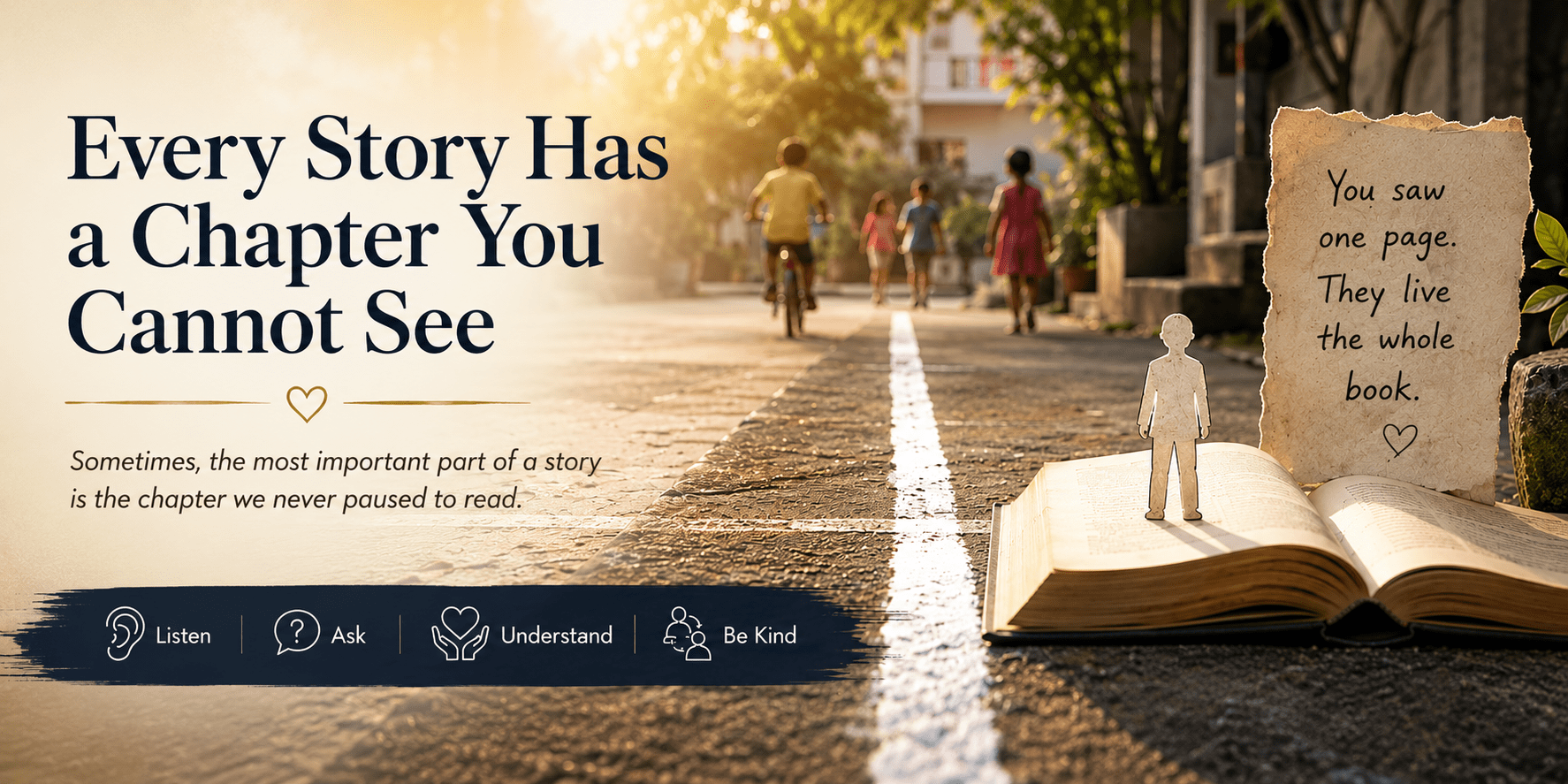
The first brushstroke took less than a minute.

A maintenance worker dipped his roller into a bucket of white paint and carefully drew a straight line across a concrete pathway inside a residential housing society in Mumbai. It was an ordinary afternoon. Children cycled through the compound while someone returned home carrying grocery bags. Neighbours exchanged greetings before disappearing behind closing doors. Nothing about those few moments suggested that the line would soon travel far beyond the society gates.
A photograph was taken.
Within hours, it had reached thousands of mobile phones. People who had never walked that pathway, never spoken to the residents, and never witnessed the conversations that preceded the decision began interpreting what they saw. Some viewed the line as exclusion. Others saw privilege. Many connected it to larger debates that already existed in society.
The white paint remained exactly where it had always been.
Its meaning changed with every person who looked at it.
Days later, more details emerged. According to residents and subsequent reports, the line had been painted to accommodate barefoot spiritual visitors during the intense summer heat while respecting practices rooted in non-violence and care for living beings. Whether everyone agreed with the decision is a separate conversation. Whether another solution might have been possible is equally valid.
But by then, something far more revealing had already happened.
Millions of people had formed an opinion before the story had found its beginning.
The internet had completed a book after reading only its cover.
Why We Create Stories in Our Minds
The incident stayed with us, not because of the paint, but because of what it quietly revealed about ourselves.
Every day, we inherit unfinished stories. A colleague walks into work unusually quiet. A teacher seems stricter than usual. A stranger snaps at a cashier. A teenager rolls their eyes at a parent. Someone leaves a family gathering early. Someone does not reply to a message.
Each moment arrives like a single page torn from the middle of a novel. Yet somehow, we convince ourselves we know how the story begins and how it ends.
The human mind dislikes unanswered questions. When information is missing, it instinctively fills the gaps with assumptions. Sometimes those assumptions are accurate. More often, they are simply the quickest explanation available.
Imagine walking into a cinema just before the final scene. Two people are arguing. One walks away. Another begins to cry. The credits roll.
As you leave, someone asks what the film was about.
You answer confidently, “It was a story about betrayal.”
But was it?
Perhaps it was a story about forgiveness. Perhaps those tears were tears of relief. Perhaps the person walking away was making the greatest sacrifice of their life.
Without the beginning, the ending becomes whatever our imagination chooses to believe.
Life is rarely different.
Every day, we meet people halfway through their stories.
The Invisible Chapters Behind Every Person

Think about the last message you sent that went unanswered.
An hour passed.
Then another.
Your mind quietly began writing its own version of events.
“They’re upset with me.”
“I must have said something wrong.”
Then the reply finally arrived.
“I’m sorry. I’ve been at the hospital all day.”
Nothing about the silence had changed.
Only its meaning.
Context has a remarkable ability to transform what we thought we already understood.
That is why misunderstandings hurt so deeply, not because people saw what we did, but because they never saw what came before.
Our lives are filled with invisible chapters.
Every morning, a security guard greets hundreds of employees entering an office building. Most know his face. Few know that every extra shift he works is helping pay for his daughter’s education in a village hundreds of kilometres away.
A retired schoolteacher waters the same jasmine plant every evening. Neighbours think she simply enjoys gardening. They never learn that her late husband planted it on the day they moved into their first home together, and caring for it has become her quiet conversation with the life they built.
A father irons his daughter’s school uniform long after everyone has gone to sleep. In the morning, she walks into school smiling, never realising that love had stayed awake long after she had fallen asleep.
These stories are fictional.
Yet they are true.
Not because these exact people exist, but because millions of people like them do.
Every neighbourhood carries invisible biographies. Every family protects sacrifices that never become conversations. Every ordinary life contains extraordinary chapters that the world rarely sees.
A Single Photograph Never Tells the Whole Story
The white line in Mumbai became more than a line.
It became a mirror.
Not because it reflected one housing society or one decision, but because it reflected us.
It showed how quickly we complete stories whose beginnings we have never seen. It reminded us that certainty often travels faster than understanding.
A photograph captures a moment.
A story restores a journey.
The paint never changed.
Only our understanding did.
Perhaps that is why stories matter.
Not because they make life more dramatic.
Because they make people more understandable.
A headline tells us what happened.
A story tells us what it felt like.
A photograph shows us a face.
A story introduces us to the person behind it.
Facts help us understand events.
Stories help us understand people.
Without stories, facts can leave us standing at the edge of someone else’s life, convinced we have seen the whole landscape when we have only glimpsed the horizon.
Stories do not erase disagreement. They simply remind us that disagreement becomes more thoughtful when we remember the humanity of the person standing on the other side.
Every meaningful story begins with the same quiet act:
Listening long enough for another human being to finish the chapters the world never paused to read.
Before You Turn the Page
One day, it will be our turn.
Someone will misunderstand our silence.
Question our intentions.
Judge a decision without knowing the years that shaped it.
When that day comes, we will hope for something very simple.
Not universal agreement.
Not endless sympathy.
Just one person willing to ask,
“Tell me what happened.”
Because deep down, every one of us longs for the same grace: to be understood before we are judged, to be heard before we are labelled, and to be known for the whole story rather than the page someone happened to open.
The browser tab will close.
Another notification will appear.
Another photograph will ask for our opinion.
Another unfinished story will arrive on our screens.
The world will not slow down.
But perhaps we can.
Perhaps the next time certainty arrives first, we will remember that context is often still on its way. Perhaps we will pause before deciding what a photograph means. Perhaps we will ask one more question.
Because every day, the world hands us unfinished stories.
What we choose to do with them says as much about us as it does about the people living them.
Maybe that is the quiet purpose of storytelling.
Not to change the facts.
But to change the way we see each other.
Because every soul has a story.
And every story deserves the dignity of being understood in full.
Story of Souls
Every soul has a story.
FAQs
Why do people judge others so quickly?
People naturally fill gaps in missing information. When we do not know the full story, our brains create assumptions based on limited facts, personal experiences, and existing beliefs. Taking time to seek context often leads to greater understanding and fewer misunderstandings.
Why is context important before judging someone?
Context explains the experiences, circumstances, and motivations behind a person’s actions. Without it, we only see a small part of someone’s story, making it easy to misinterpret their behaviour or intentions.
What can a story teach us that facts cannot?
Facts explain what happened. Stories reveal why it happened and how it affected the people involved. They add emotion, perspective, and humanity, helping us connect with experiences beyond our own.
How do assumptions affect relationships?
Assumptions can lead to misunderstandings, unnecessary conflict, and damaged trust. Asking questions and listening before reaching conclusions creates stronger, healthier relationships.
Why should we avoid judging people based on a single moment?
A single moment rarely reflects an entire life. Everyone carries experiences, struggles, and sacrifices that are not immediately visible. Looking beyond first impressions helps us respond with greater empathy and fairness.
What is the message behind “Every Story Has a Chapter You Cannot See”?
The message reminds us that every person has unseen experiences that shape their choices. Before forming opinions, it is worth remembering that we are often seeing only one page of a much larger story.
How can storytelling help build empathy?
Stories allow us to understand another person’s emotions, motivations, and perspective. By seeing life through someone else’s experiences, we become more compassionate, patient, and open-minded.
Why do photographs and headlines sometimes create misleading impressions?
Photographs and headlines capture only a brief moment or a limited perspective. Without the surrounding context, people may interpret events differently from what actually happened.
What does it mean that every soul has a story?
It means every person has lived through unique experiences, joys, challenges, and lessons that shape who they are. Taking time to understand those stories encourages kindness, respect, and meaningful human connection.
Our Storyteller: Alifia Olia

Alifia Olia calls Mumbai home, and Mumbai, in many ways, has shaped everything she writes.
A senior ad copywriter with years spent crafting language for some of the city’s leading agencies, Alifia brings to Story of Souls an unhurried truth. As Co-founder of the platform, she has been part of building a space where ordinary people find their stories taken seriously and written about with care.
History was her first passion. That love for the past taught her something that stays with her today: that the present is always being written, and someone needs to be paying close attention.
She writes about people who persist, cities that breathe and struggle and things that we often overlook. Her features span empowerment, current affairs, and culture.
When she is not writing, she is travelling; not to destinations, but towards people. She loves meeting strangers as much as spending time in nature. She also takes group and individual learning sessions for children.
At Story of Souls, Alifia believes what the platform has always believed: that if you want to truly know someone, you must know their story first.
About Story of Souls
Leave your comments on how you like this story. If you love it, share it to bring that change we wish to see in the world.
You can also share your inspiring story with us at submitstories.storyofsouls@gmail.com. Story of Souls is an initiative where we invite people to bring their stories to us. We want people to “write to heal.” The idea of Storyofsouls is appreciated by ALL INDIA RADIO. An Online Platform where you can share your real-life stories. The impact of our stories has reached the UN and Harvard University. For some real-life stories, web series are also planned. You can also visit our YouTube channel. You can follow us on Facebook LinkedIn Instagram.
Storyofsouls is glad to inform you that we are now a Google News-verified platform.
We are proud to inform you all that storyofsouls.com is the official TEDx MotiJheel Kanpur Partner for their upcoming event.