


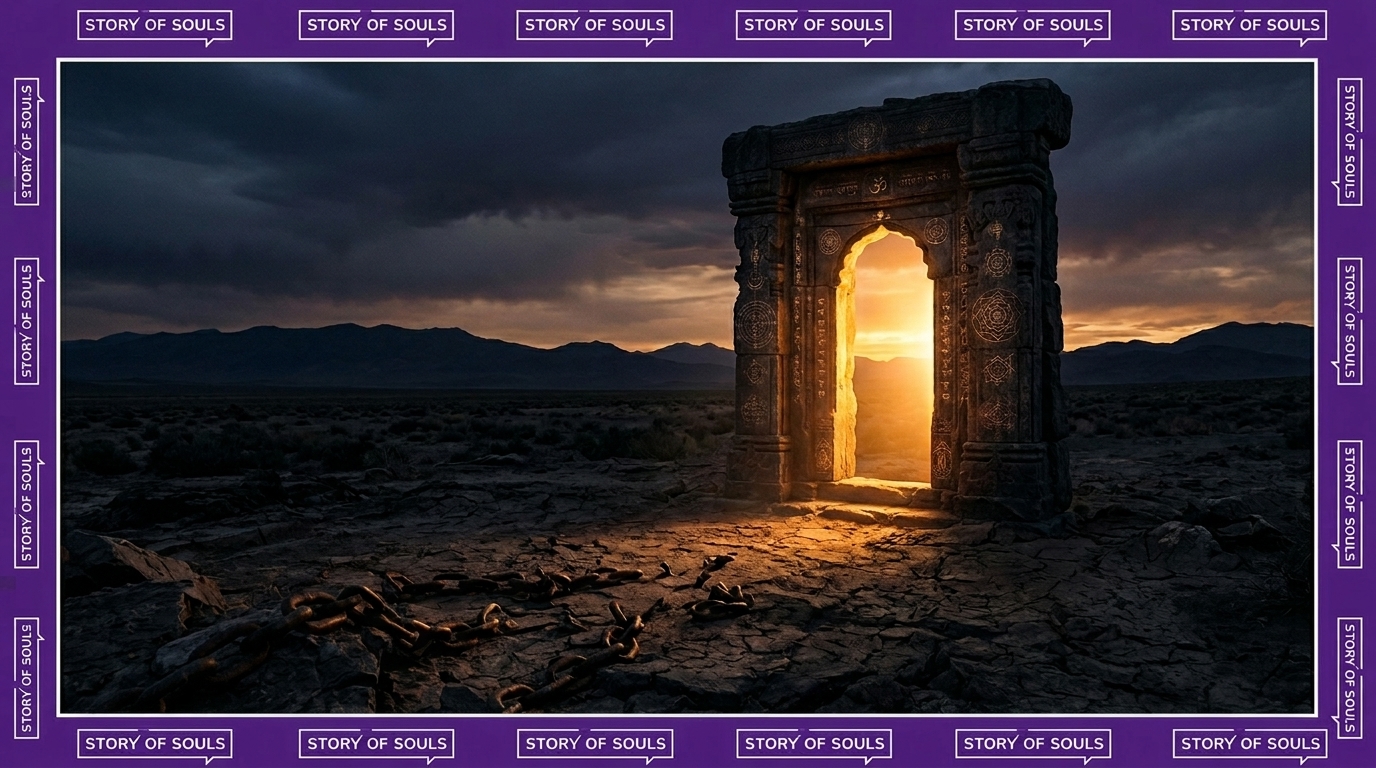
Before the gotra was named, before the caste was recorded, before the ritual was written — there was a breath. One breath. And it was the same, in every chest, in every body, across every geography this earth holds.

Then came the naming. The dividing. The deciding.
And somewhere in the long, complicated corridor of human history, a certain kind of person discovered something dangerous: that if you could make others believe the divisions were sacred, you would never have to justify your power. You could simply inherit it.
The Gotra Question: Purity or Control?
The gotra system, in its original Vedic conception, was a genealogical tracker. It helped identify patrilineal descent, primarily to avoid inbreeding within closely related families. It was, at its root, a practical arrangement rooted in biology — not a spiritual passport to moksha.
Yet somewhere along the way, it became something else entirely. It became a weapon. A wall. A way to tell someone: you do not belong here. Your blood is wrong. Your love is invalid. Your very existence, outside these lines, is a rebellion.
To say that moksha — liberation of the soul — depends on which gotra you were born into is to say that God is a bureaucrat with a caste register.
Think about what moksha actually means in the Hindu philosophical tradition. It is release from the cycle of birth and death. It is the dissolution of the ego, the merging of the individual self with the universal consciousness. It is the end of all separateness.
And we are told this liberation — this ultimate, boundless freedom — is available only to those who followed the correct gotra rules?
If that were true, then moksha is not liberation at all. It is just a more exclusive club.
The DNA Paradox
Here is where the argument against the gotra system collapses under the weight of its own logic.
Modern genetics — and ancient Vedantic philosophy, interestingly — both arrive at the same conclusion: we are one. Every human alive today shares a common ancestry. Scientists trace the mitochondrial DNA of every woman on earth to a single maternal ancestor. Every man’s Y chromosome traces to a single paternal line. These are not metaphors. These are measurable, sequenced, scientific facts.
The Vedas themselves speak of Brahman — the singular, undivided consciousness from which all life emerges. The Upanishads declare: Tat tvam asi. That thou art. You are that. The same infinite that exists in the universe exists in you. And in the person you were told not to marry.
So if all life originates from one source — one DNA, one Brahman, one original breath — then the argument that mixing gotras dilutes purity is not a spiritual position. It is a political one. It is the argument of a family that was slightly more powerful than another family, a long time ago, and wanted to make sure it stayed that way.
The strongest branch does not become stronger by refusing to touch the other branches. It becomes brittle.
The Body Does Not Know Caste
Let us sit with something simple and unarguable for a moment.
A surgeon performing open-heart surgery does not pause to check the patient’s caste before making the incision. Because the heart is the same. The blood is red in every chest. Oxygen travels the same route, through the same architecture of veins and capillaries, whether the body belongs to a Brahmin or a Dalit, a Hindu or a Muslim, a gotra-compliant family or a “rebel.”
The body, in its infinite wisdom, does not discriminate. It simply sustains life. Quietly. Without judgment.
It is only the mind — conditioned, frightened, power-hungry — that learned to draw lines on the body and call them sacred.
The body bleeds the same colour. The mind is where the divisions live.
Children are born the same way, across every community on earth. They arrive crying, small, completely dependent, completely equal. No child is born knowing their caste. No infant arrives with a gotra tattooed on their wrist. These things are taught. And what is taught can be unlearned.
The Rebel and the Gatekeeper
They call her a rebel. They call him a disgrace. They say the family that chose love over lineage has brought shame upon the bloodline.
But let us look carefully at who is doing the calling.
Look at the families that enforce these rules most aggressively. Look at the households that cast out their daughters for marrying outside the gotra, that sit in community panchayats to decide the fate of other people’s lives. Look at them — really look — behind the closed doors.
Is there peace there? Is there love? Do the children in those families laugh freely? Do the marriages hold tenderness? Are the elderly treated with warmth? Is the home a place of safety?
More often than not, the answer is no. The loudest enforcers of community purity tend to be the ones drowning in their own private chaos. Marriages held together by fear, not affection. Children who have never been told they are enough. Generations of unspoken grief, passed down like heirlooms no one wanted but everyone kept.
And yet — this is the person who will decide whether you deserve moksha.
A man who cannot keep peace in his own home has no standing to be the gatekeeper of anyone else’s salvation.
The Violence of Social Judgment
It begins with whispers. Then with exclusion. Then with warnings. And then, in far too many cases across this country and across the world, it ends in violence.
Honor killings are not committed by monsters from another world. They are committed by fathers and uncles and brothers who genuinely believe they are protecting something sacred. That belief — that absolute, unquestioned, inherited belief — is the most dangerous thing a human being can carry.
Because a belief that justifies violence against a beloved is not a spiritual belief. It is a wound pretending to be a value.
The person who is killed for loving outside the gotra is not a rebel. They are a human being who chose their own heart over someone else’s fear. And the community that calls that choice a sin — that community has already lost its claim to speak about dharma, about righteousness, about the sacred.
Who Owns Society?
This is the question that should make all of us restless.
In a democracy, the answer is supposed to be: no one. And everyone. Equally.
But in practice, “society” is often a small, loud, self-appointed group of people who have confused their personal anxieties with universal law. They call meetings. They pass judgments. They issue decrees about who can eat where, who can love whom, who is clean and who is polluted.
And when someone breaks their rules, the same society that should be asking — what kind of community drives its own members toward despair — instead asks only: how do we punish them?
Meanwhile, the same community that won’t tolerate a love marriage across gotra lines will tolerate domestic violence within them. It will quietly accept the alcoholic patriarch. It will cover for the abusive husband. It will shun the widow who tries to rebuild her life, but welcome back the man who destroyed his family.
The garbage they are most concerned with discarding is always other people. Their own is composted into silence.
A society that polices love but ignores cruelty has confused purity with power.
The Bloodline That Is Truly Weakening
Let us return to the question of the bloodline. Because it is being weakened — but not in the way the gatekeepers claim.
The bloodline weakens when children grow up in homes where they are not seen. Where love is conditional and approval is currency. Where a daughter’s worth is measured by the family she marries into, and a son’s success is measured by how well he enforces the rules he inherited.
The bloodline weakens when young people cannot follow their conscience without fearing exile. When the cost of authenticity is belonging.
The bloodline weakens when elders spend their final years surrounded by obligation rather than affection, having spent a lifetime enforcing rules instead of building connections.
These families — the ones most loudly concerned with gotra purity — are often among the most emotionally impoverished. Not because the gotra system failed them. But because in protecting the system, they forgot to protect each other.
And what of their moksha? What of the liberation they promised themselves in exchange for a lifetime of compliance and control? Do the rigid families achieve liberation? Or do they simply hand the cage to the next generation, freshly polished, with a new padlock?
What the Ancient Texts Actually Say
The Bhagavad Gita does not say: perform your duty only within your gotra and liberation will follow. Krishna tells Arjuna: rise above the dualities. See the self in all beings. Act without attachment to outcome.
The Yoga Vasistha speaks of liberation through direct inquiry into the nature of the self — not through the maintenance of social hierarchies.
Even Manusmriti — often cited to justify caste restrictions — is a text of its time, written by men, reflecting the social anxieties of a particular era. It is not the voice of God. It is the voice of a society trying to manage its own complexity and, in doing so, building walls around its own humanity.
The seers — the rishis whose lineages gave us the gotra names in the first place — were seekers. They left the city. They sat in forests. They questioned everything. The gotra system that claims their name would have been unrecognizable to them.
A Democracy of the Soul
If there is one thing every major spiritual tradition agrees on, it is this: the soul does not belong to any community. It does not carry a caste certificate. It is not subject to the jurisdiction of any panchayat.
The soul, by its very nature, is free.
And the most radical, the most ancient, the most truly Hindu idea in existence is this: you are not the body. You are not the name. You are not the lineage. You are the consciousness that observes all of it — the Atman, which is identical to Brahman, which is the same in every being, across every gotra, across every caste, across every border this frightened world has drawn.
Moksha is not granted by society. It cannot be revoked by society. It is the recognition, finally, that you were always free.
The person who marries outside the gotra and spends their life in love — they are closer to moksha than the one who married correctly and spent their life in resentment.
The family that was ostracized for its choices but chose dignity over bitterness — they are living the teaching that the ancient texts struggled to put into words.
And the community that sat in judgment, that spread violence in the name of purity, that called itself the keeper of tradition while forgetting the tradition’s deepest purpose — that community has its own reckoning waiting. Not in some divine courtroom. But right here, in the quiet of their own homes, in the eyes of their own children, in the unhappiness they can feel but cannot name.
The Question We Must All Ask
If your tradition asks you to hate someone for loving outside its lines — is that a tradition worth keeping?
If your community’s purity can only be maintained through someone else’s suffering — is that purity, or is it simply domination wearing a religious costume?
If the rules that govern your life were written by people long dead, for a world that no longer exists, to serve power structures that have since collapsed — are you following dharma, or are you following inertia?
And if the family that enforces these rules is itself broken, unhappy, and silent — whose bloodline are they actually protecting?
These are not rebellious questions. They are the oldest questions there are. The same questions the rishis asked when they left the city and sat alone with the night sky.
They are the questions that have always — always — preceded liberation.
The soul does not need society’s permission to be free. It only needs the courage to ask what freedom actually means.
— Published on Story of Souls
storyofsouls.com












Thanks for the sensible critique. Me and my neighbor were just preparing to do some research about this. We got a grab a book from our area library but I think I learned more from this post. I’m very glad to see such excellent information being shared freely out there.